
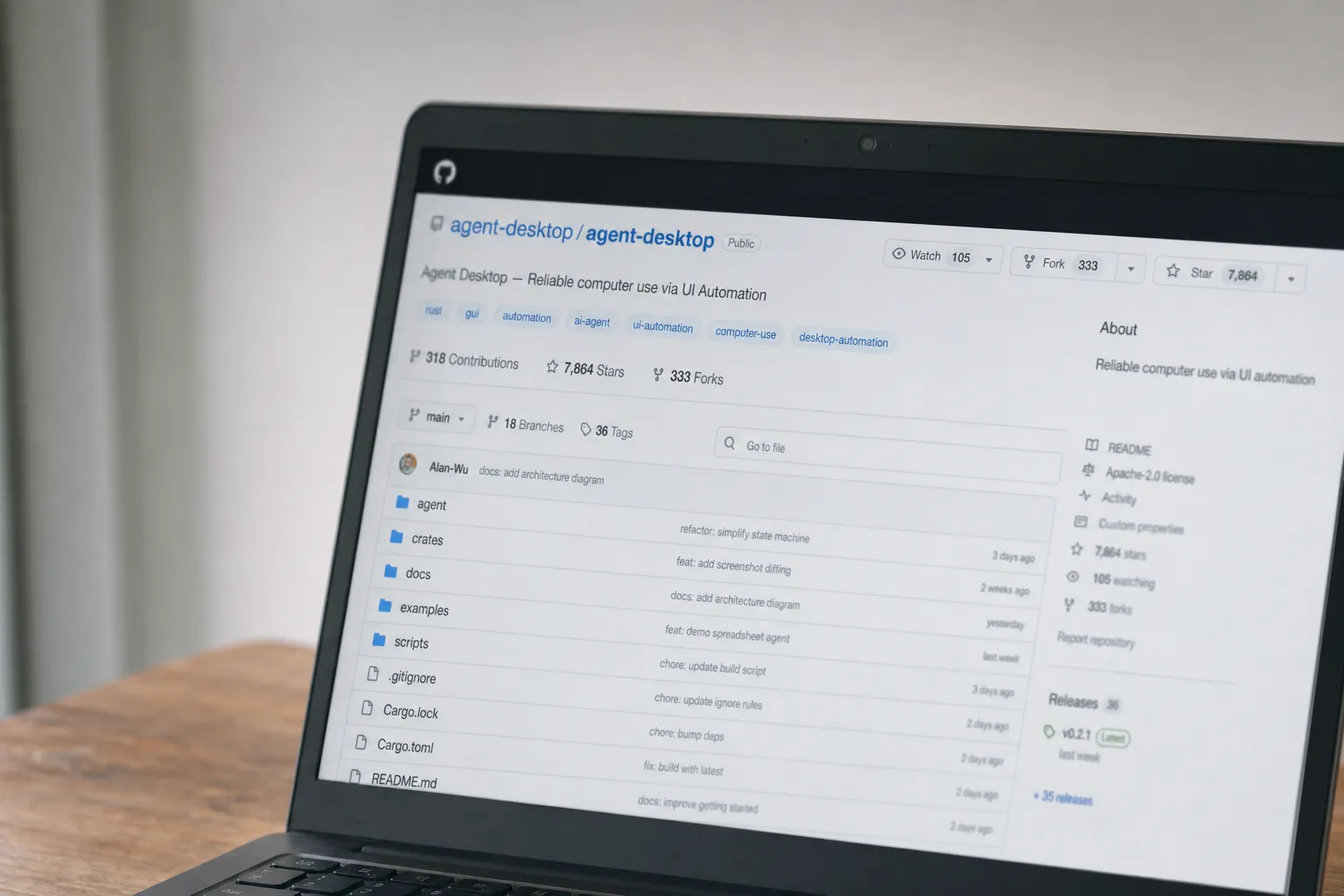
Agent Desktop, an open-source framework from Vercel Labs, has rapidly gained developer attention with nearly 8,000 GitHub stars and a surge of 2,243 stars in a single day. Built in Rust and released earlier this year, the tool addresses a fundamental problem in autonomous agent development: reliably automating desktop and application workflows. Rather than using computer vision to interpret pixel data, Agent Desktop leverages OS accessibility trees—the standardized data structures that operating systems expose about UI structure. This approach provides agents with semantic understanding of interface elements, making actions more deterministic and repeatable.
The technical advantages of this architecture are significant for production AI agent systems. By reading accessibility APIs instead of processing screenshots, Agent Desktop ensures that UI element references remain stable across different screen resolutions, scaling factors, and visual themes. Actions become safely retryable without the brittleness that plagues vision-based approaches. This represents a mature engineering decision that prioritizes reliability over the simplistic elegance of image-based interaction, addressing real concerns from teams deploying agents in enterprise environments where consistency matters more than generality.
The rapid adoption suggests the AI agent development community is converging on certain architectural patterns. Alongside Agent Desktop, projects like anatomy (an agent skill for interactive isometric illustrations) and unslop (Claude skill for UI refinement) demonstrate developers shipping specialized tools within larger agent ecosystems. This emerging landscape shows teams moving beyond proof-of-concept LLM wrappers toward purpose-built infrastructure that makes autonomous systems actually deployable—focusing on what practitioners can reliably ship rather than what demos impressively.