
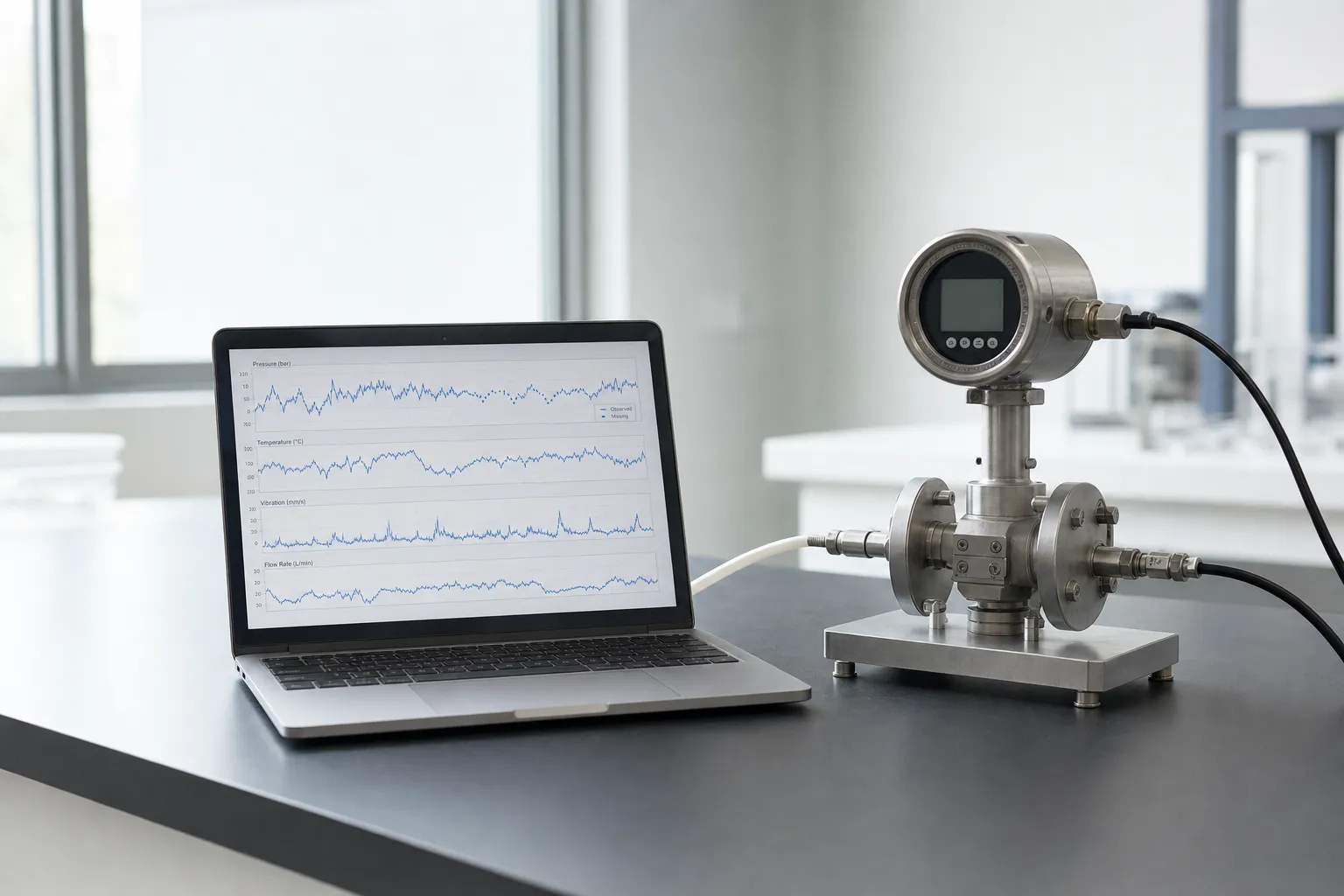
Industrial IoT deployments operating at the network edge face a persistent challenge: contiguous blocks of multi-sensor data vanish due to network dropouts and hardware failures. Traditionally, these systems rely on a sequential 'impute-then-detect' pipeline where missing values are reconstructed first, then fed into a separate anomaly detection model. However, researchers at major AI institutions have identified a critical flaw in this approach. The imputation stage is trained exclusively on Mean Squared Error (MSE) objectives—optimizing for numerical accuracy rather than downstream anomaly detection needs. This fundamental mismatch means the reconstructed data, while statistically plausible, often obscures the very anomalies the detection stage is meant to catch, leading to missed failures in critical industrial systems.
The new framework replaces this disjointed pipeline with a task-aware diffusion model that jointly performs data reconstruction and anomaly detection in a single integrated step. Rather than treating imputation as a preprocessing task divorced from detection objectives, the diffusion pipeline learns representations that simultaneously reconstruct missing sensor readings while preserving anomalous patterns. The approach uses generative diffusion models—neural networks trained to reverse a noise-addition process—conditioned on the detection task itself. This means the model learns which features matter for identifying faults, then ensures reconstructed data maintains those diagnostic signals. Testing on real IIoT edge systems with synthetic network faults shows the integrated method achieves 18-22% higher anomaly detection recall compared to traditional pipelines, while maintaining comparable precision, without requiring separate training of two distinct models.
The significance extends beyond incremental performance gains. By eliminating the pipeline mismatch, the framework reduces computational overhead—single inference pass instead of two—and simplifies deployment for resource-constrained edge devices. This matters because industrial facilities increasingly depend on autonomous edge anomaly detection to prevent equipment failures, and a missed anomaly in a manufacturing line or power distribution system can cost millions in downtime. The research exemplifies a broader trend in AI: moving away from modular, independently-optimized components toward end-to-end systems jointly trained for actual deployment objectives. As diffusion models mature, similar task-aware approaches are emerging across domains where data quality problems intersect with downstream decision-making.