
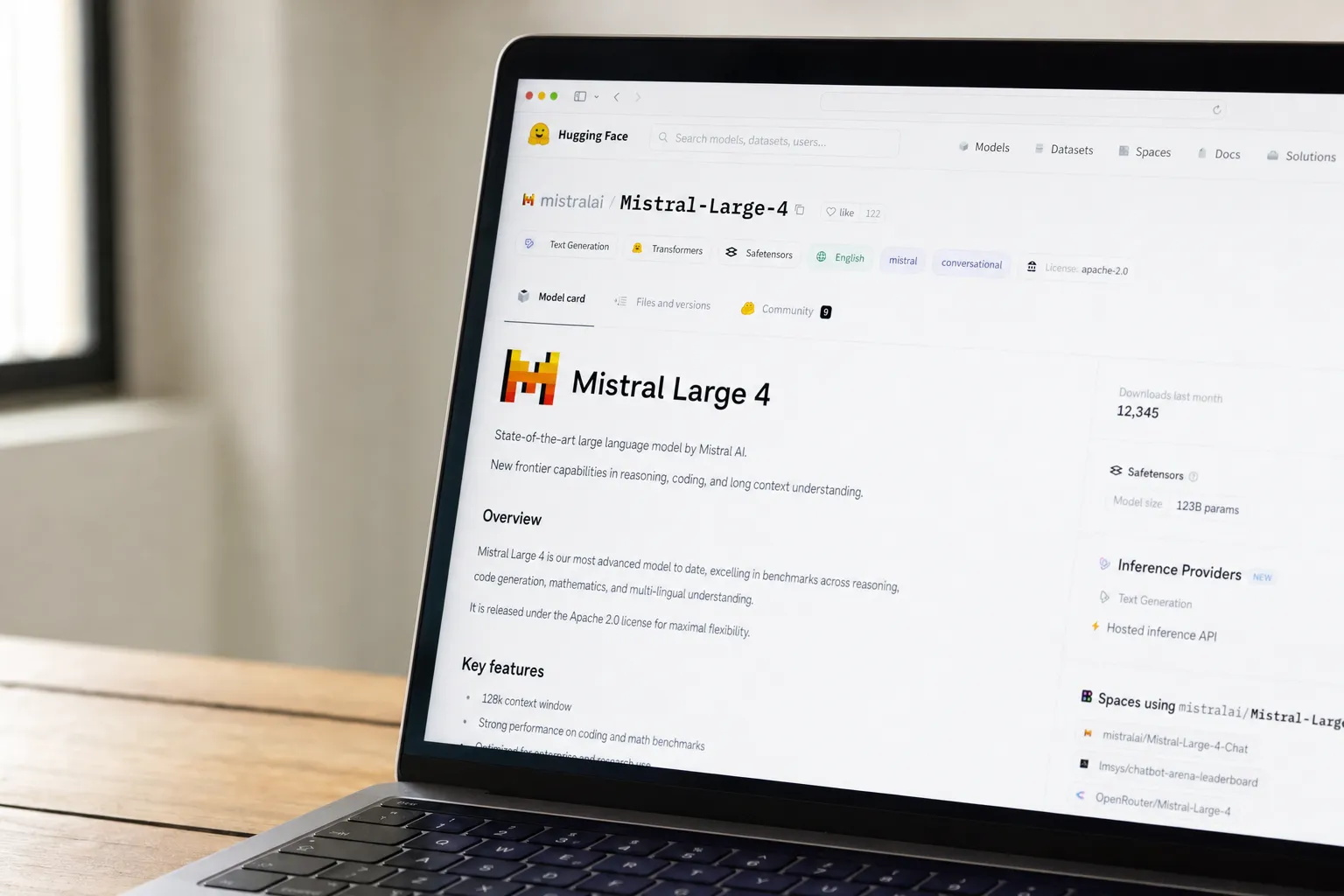
Mistral has released Mistral Large 4 on HuggingFace, marking a significant moment in open-source AI development where frontier-class model capabilities are becoming accessible for local deployment and self-hosting. The release represents Mistral's flagship offering in their model lineup—positioned above their Mistral 8x22B mixture-of-experts variant and standard Mistral models—bringing state-of-the-art instruction-following and reasoning capabilities to the open ecosystem. Unlike proprietary alternatives from larger cloud providers, Mistral Large 4 can be run on consumer and enterprise hardware through frameworks like Ollama and llama.cpp, democratizing access to advanced AI capabilities. The timing matters: as organizations increasingly seek to reduce dependency on API-based services and maintain data sovereignty, the availability of genuinely capable open models at this tier fills a critical gap in the self-hosting landscape. This release directly challenges Meta's Llama 3.1 series, which has dominated the open-source frontier-class conversation, forcing a competitive reckoning in model quality, efficiency, and real-world performance.
The technical specifications reveal why this release commands attention from practitioners building production systems. Mistral Large 4 demonstrates competitive performance on standard benchmarks including MMLU (common sense reasoning), HumanEval (code generation), and mathematical problem-solving tasks. Early community deployment reports indicate the model achieves strong multi-lingual support and maintains competitive inference speed characteristics across quantized variants (4-bit, 8-bit) suitable for consumer hardware with 24GB+ VRAM, making it practical for organizations running inference on a single high-end GPU or distributed across modest server clusters. The model's architecture emphasizes efficiency gains over raw parameter count compared to competing frontier offerings, addressing a persistent pain point in the self-hosted community: the tension between capability and computational practicality. For teams currently weighing Llama 3.1 405B versus smaller capable models, Mistral Large 4 presents a third compelling option with distinct trade-offs in performance density and deployment flexibility.
This release arrives amid broader ecosystem momentum in open-source AI tooling. Complementary developments like Granite Switch 4.1.1—enabling model updates with software-like precision—and rising adoption of agent orchestration frameworks (evidenced by community tools like Paperclip reaching 110K stars) indicate the open ecosystem is maturing beyond isolated model releases into cohesive, production-ready stacks. Organizations can now deploy Mistral Large 4 through established pipelines with version control, local quantization, and integration frameworks that rival closed-source deployment complexity. The HuggingFace release specifically matters because it positions the model within the community's primary model-discovery and sharing infrastructure, ensuring accessibility for researchers, startups, and enterprises evaluating self-hosting strategies. As frontier-class models become genuinely commoditized through open releases, the competitive advantage shifts toward deployment flexibility, fine-tuning capability, and integration into broader AI systems—terrain where Mistral's ecosystem strategy is gaining ground.