
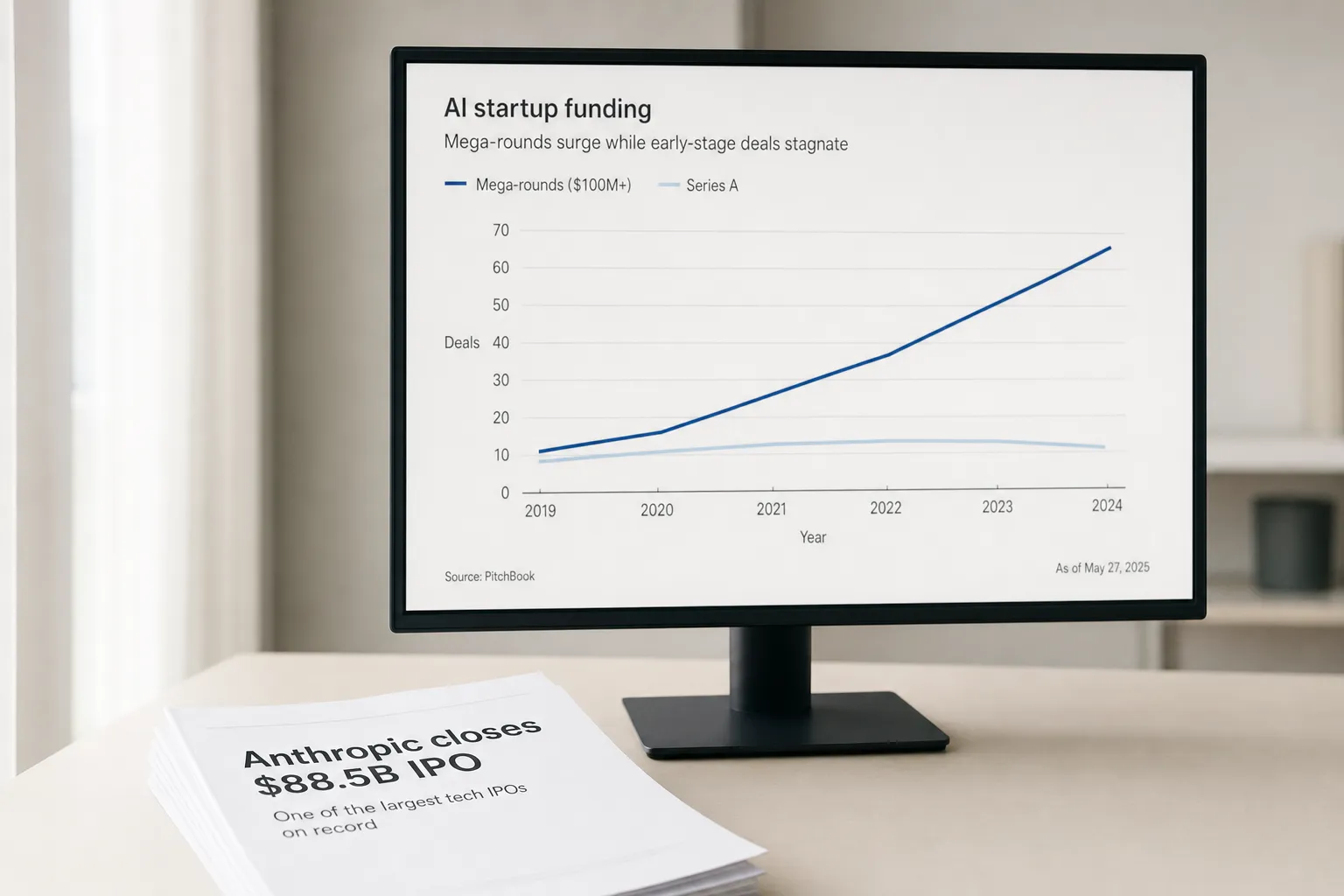
Anthropic's pursuit of $88.5 billion through an initial public offering and concurrent private placement represents the largest fundraise tied to a public market debut, but the headline obscures a more consequential trend: capital is consolidating at the frontier. The S-1 filing crystallizes how mega-scale AI companies now operate in a funding tier fundamentally separated from traditional venture economics. Developing competitive foundation models requires multi-billion-dollar outlays for compute infrastructure, talent acquisition, and iterative training—a capital intensity that has created a chasm between frontier players and earlier-stage competitors. Anthropic joins a small cohort of ultra-funded companies, including xAI, Mistral AI, and Scale AI, that command outsized institutional investment. These mega-rounds reflect investor conviction that dominance in foundation models generates disproportionate returns, but they also signal something darker: a market structure where only players with access to exceptional capital can compete for AI's highest-value applications.
The Series A funding market exposes the bifurcation. Through October 2026, U.S. Series A companies raised $42 billion—a 60 percent increase year-over-year that suggests robust early-stage capital availability. Yet deal counts have remained essentially flat compared to 2025, neither expanding nor contracting meaningfully. This creates a paradox: more capital flowing to fewer startups. The implication is stark—larger rounds for proven teams, narrower windows for newer founders. Capital efficiency has become ruthless; only founders with strong networks, prior exits, or impressive product traction are clearing Series A thresholds. For everyone else, the fundraising window has compressed. This is not a liquidity crisis but a selectivity crisis: investors have more to deploy but are deploying it more conservatively, clustering bets around teams and markets with proven execution.
The emerging two-tier AI funding system has ecosystem-wide consequences. Mega-funded companies enjoy compounding advantages—superior talent recruitment, faster iteration, stronger leverage with cloud and chip providers. Meanwhile, Series A startups increasingly hunt for defensible niches in vertical AI, enterprise software, and infrastructure tooling, where network effects offer less categorical advantage than foundation model dominance. This mirrors historical platform shifts where a small number of companies capture disproportionate value. For investors and operators, the signal is clear: mega-capital will continue concentrating in frontier labs while specialized competitors carve narrow moats. The question now is whether this stratification accelerates AI's adoption and competition, or suppresses the creative pressure that drives breakthroughs. Either way, the 2026 funding split is structural, not cyclical—expect it to deepen.