
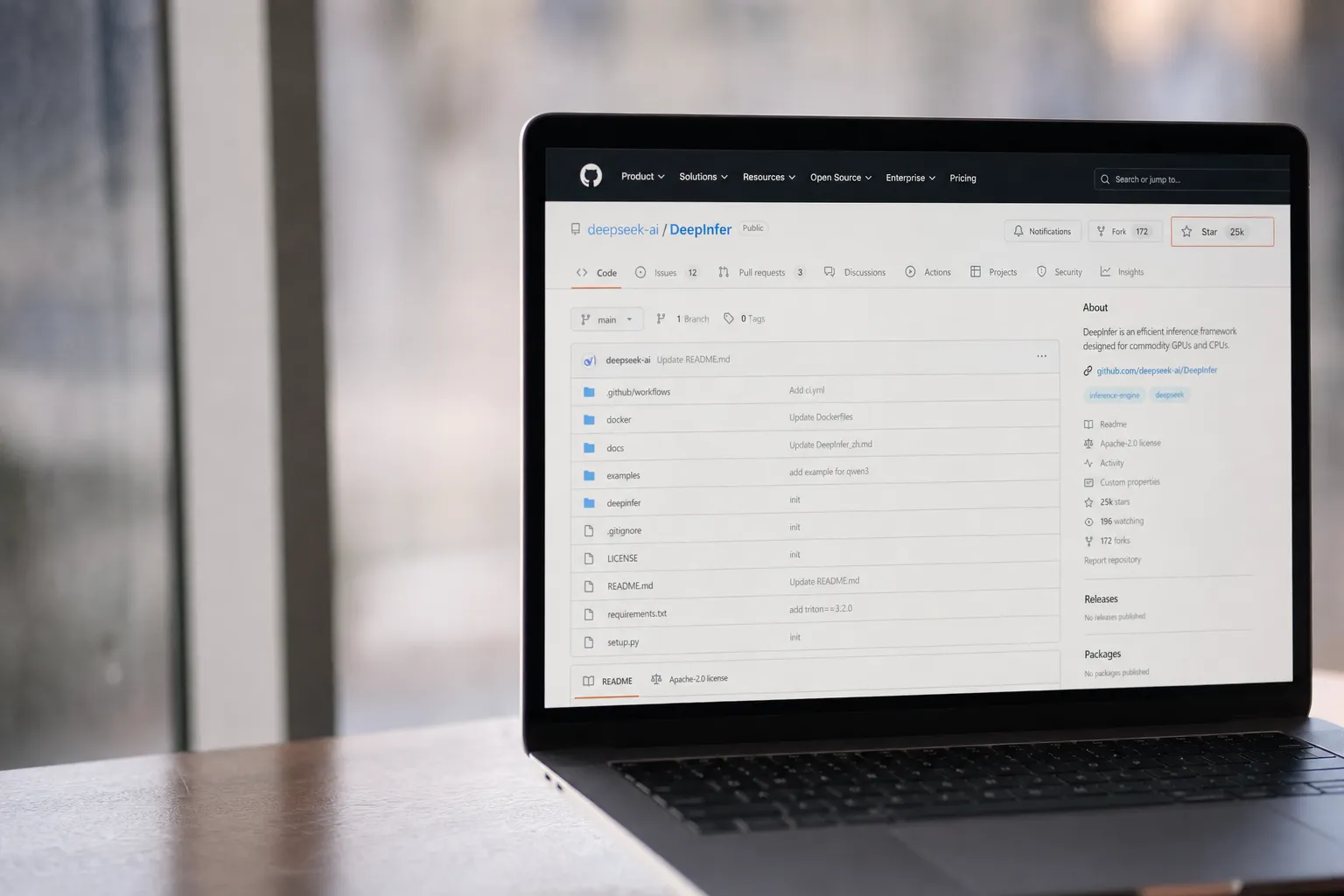
DeepInfer's emergence as a high-performance inference framework for DeepSeek models catalyzed rapid adoption within the open-source AI community, with velocity that suggests a structural shift in how developers approach AI deployment. The project reached 25,782 stars on GitHub within 25 days of its October 16 launch, accumulating approximately 1,024 stars daily—a rate that exceeds most infrastructure projects and signals serious developer demand for locally-deployable, large-scale inference solutions. Released under Apache 2.0 and written in Python, the framework addresses a critical infrastructure gap: making advanced DeepSeek models viable for real-time, server-side inference without reliance on proprietary cloud APIs or rate-limited commercial services that introduce latency and recurring costs.
DeepInfer's specific optimization for DeepSeek architecture enables memory-efficient inference and reduced latency compared to generic frameworks like Ollama or llama.cpp. By targeting the architectural quirks of DeepSeek models directly, the framework achieves performance characteristics that generic inference engines cannot match without extensive tuning. This positions local DeepSeek deployment as a genuine competitive alternative for organizations seeking independence from cloud providers, not merely a cost optimization or backup option. Early adopters include academic research groups benchmarking inference efficiency and software teams integrating reasoning capabilities into applications without per-call API fees. The framework matured for production use at an inflection point: as DeepSeek's open-weight models gain credibility in multilingual reasoning tasks, removing deployment barriers becomes the limiting factor for adoption.
DeepInfer's adoption reflects a broader developer shift toward owning AI infrastructure, particularly as commercial tools face pricing pressure and feature constraints. Discussions across developer communities highlight appetite for practical, self-hosted alternatives to proprietary solutions. The October launch timing coincided with peak community interest in DeepSeek's latest model releases, but the sustained daily star gain suggests lasting infrastructure demand rather than fleeting trend interest. For production teams evaluating cost structures and data privacy requirements, and research groups optimizing inference efficiency, DeepInfer removes the practical barrier between downloading a capable model and running it reliably at scale. As the open-source AI ecosystem matures from experimental to production-grade, specialized inference frameworks become foundational infrastructure—determining which models remain viable for self-hosted deployment versus which require cloud intermediaries.