
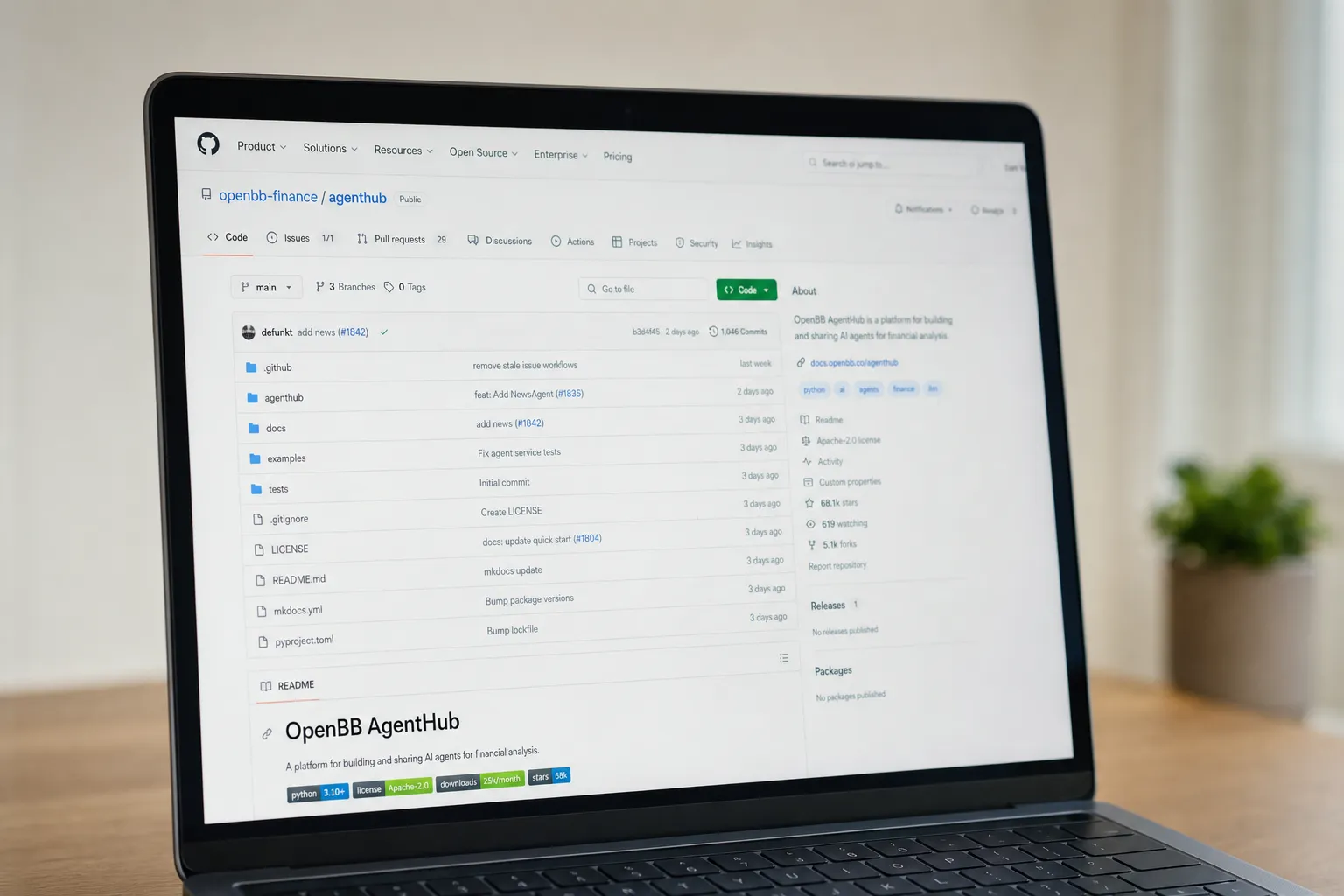
In under a year, the daily_stock_analysis project—an LLM-powered multi-market stock analysis system—has accumulated 68,455 GitHub stars and 56,306 forks, with growth accelerating to 505 new stars in a single day. The project, written in Python and licensed MIT, aggregates multi-source market data, ingests real-time news feeds, surfaces decision dashboards, and automates notifications, all built on LLM-driven inference chains. It positions itself as cost-free when scheduled on free tiers, making it accessible to retail traders and small funds. The star trajectory rivals established open-source agent frameworks—LangChain hit 50K stars in roughly 18 months; AutoGPT and CrewAI followed similar arcs but with more enterprise backing. That daily_stock_analysis achieved this with minimal visible institutional promotion suggests genuine grassroots adoption among traders actively deploying the system. Yet this raises an uncomfortable question: are developers deploying autonomous decision-making systems because they've validated correctness, or because the friction to iterate is so low that 'shipping fast' now outpaces 'shipping safely'?
The project's architecture reflects the current state of agentic development: multi-step pipelines where each failure point compounds. Real-time market data flows into preprocessing, which feeds LLM reasoning that must disambiguate noisy signals (news sentiment, volume spikes, correlation shifts), and that reasoning then informs automated trades or alerts. The documented design omits critical details: error recovery (what happens if the LLM hallucinates a price or misinterprets a headline?), backtest validation against historical stress scenarios, or circuit breakers that kill pipelines before cascading losses. This mirrors a broader pattern visible in recent HN discussions: AI teams shipping frameworks without clarity on failure modes or verification protocols. Microsoft's warning about agentic systems being weaponized to exfiltrate cloud secrets in 5 minutes underscores that autonomous agents operating on production infrastructure—financial or cloud—carry asymmetric risk. A single hallucination in a stock-analysis agent could liquidate a position. An LLM misinterpreting a market regime shift could lock in losses.
What distinguishes daily_stock_analysis from earlier waves of algorithmic finance tools is that it democratizes agent deployment—no PhD in quant finance required, just Python and an API key. This is both its strength and its liability. The 56K forks suggest active experimentation, but we lack visibility into how many forks are deployed in production, how many have been abandoned after encountering edge cases, or how many have experienced silent failures. UpTrain's emergence as a YC W23 company reflects the industry's recognition that LLM evaluation is now critical infrastructure; yet most developers shipping agentic systems aren't using formal evaluation frameworks at all. The tension is real: agentic AI is undeniably shipping to production faster than ever, but the human oversight, testing rigor, and failure-mode analysis required for financial autonomy hasn't accelerated alongside it. Daily_stock_analysis's success may signal not that agentic systems are finally mature enough for high-stakes domains, but that developers have decided to accept the risk and optimize for speed instead.