
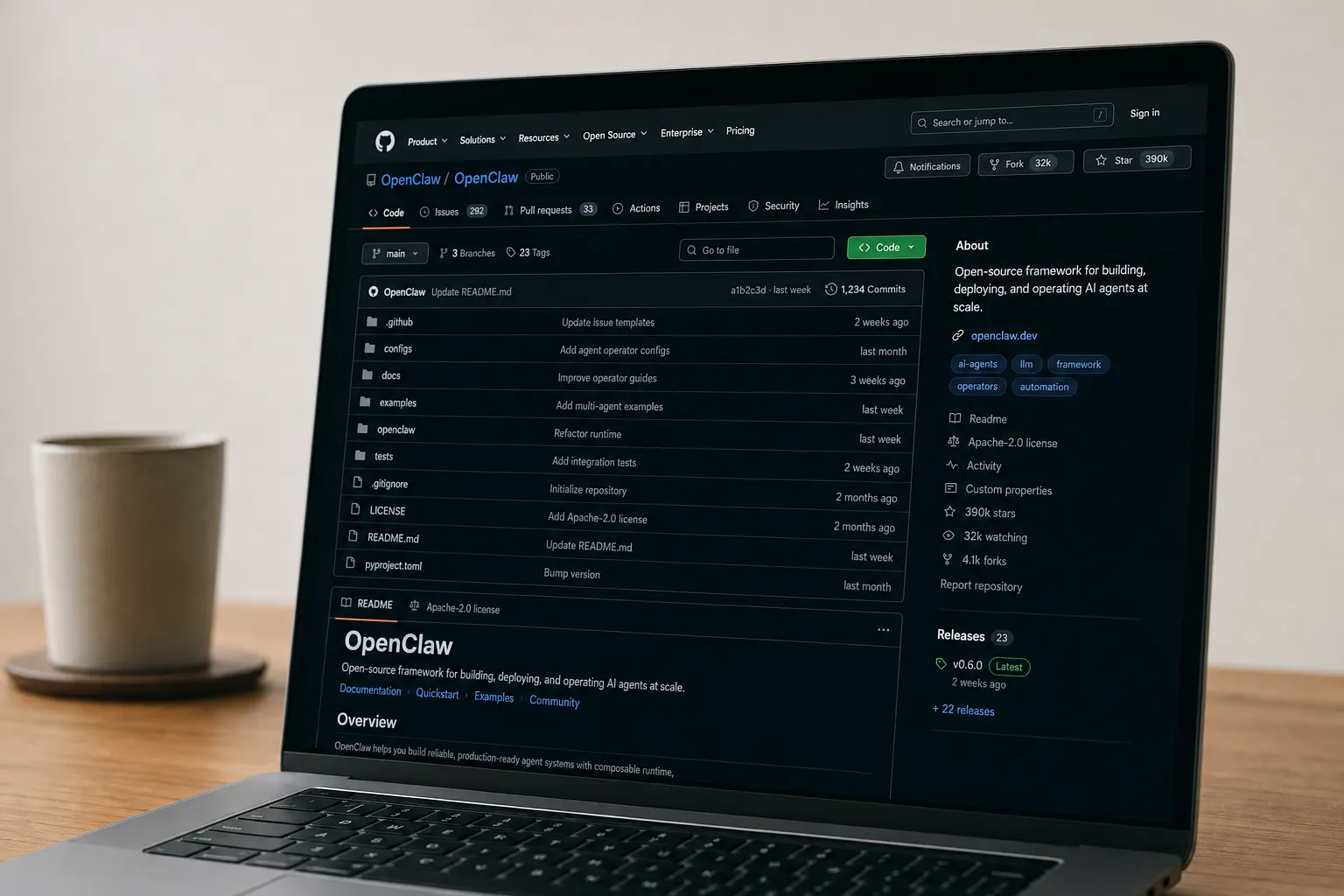
OpenClaw, a cross-platform agent framework written in TypeScript, has accumulated 394,175 GitHub stars—roughly 1,129 per day since launching 349 days ago. Marketed as "the AI that really does things," it executes on any OS and platform while remaining MIT-licensed and open-source. Today's Hacker News discussion reflects genuine developer momentum, but this is not a novelty spike. The scale of adoption reveals a fundamental shift: after two years of agent hype, developers are now building and shipping the *infrastructure* that makes agents operationally useful. This is the moment when agent frameworks move from academic research and startup experiments into tools that actual teams use in production systems.
The ecosystem around agent tooling is rapidly solidifying. Vercel's agent-browser—a Rust-based CLI for browser automation designed specifically for AI agents—has reached 47,218 stars and gained 812 stars in a single week. Meta's Astryx, a design system explicitly built to be "agent-ready," has attracted 14,996 stars in under a year. Real workflows are already emerging from these tools: a data team uses agent-browser to scrape pricing pages across 50 competitor sites daily, consolidating data that would take hours to gather manually. A QA team deploys agents across Windows, Linux, and macOS simultaneously via OpenClaw to catch platform-specific bugs in beta releases. A procurement team automates interaction with legacy web-based vendor portals that never received API updates, bridging to modern systems.
Yet production reliability remains the untested frontier. GitHub stars measure enthusiasm, not stability in deployment. A single hallucination every hundred interactions might be acceptable in a research tool but unacceptable in an agent managing financial transactions or customer data. Teams learned this lesson expensively earlier this year when agents misbehaved in production. The real question isn't whether agents can be built—the star counts prove that works—but whether these frameworks can deliver the observability, error handling, and governance that production systems demand. If agent tooling achieves that maturity, we enter a new era: agents as operational infrastructure, not experimental features. Whether OpenClaw, agent-browser, and their peers sustain adoption at that scale remains the open question.