
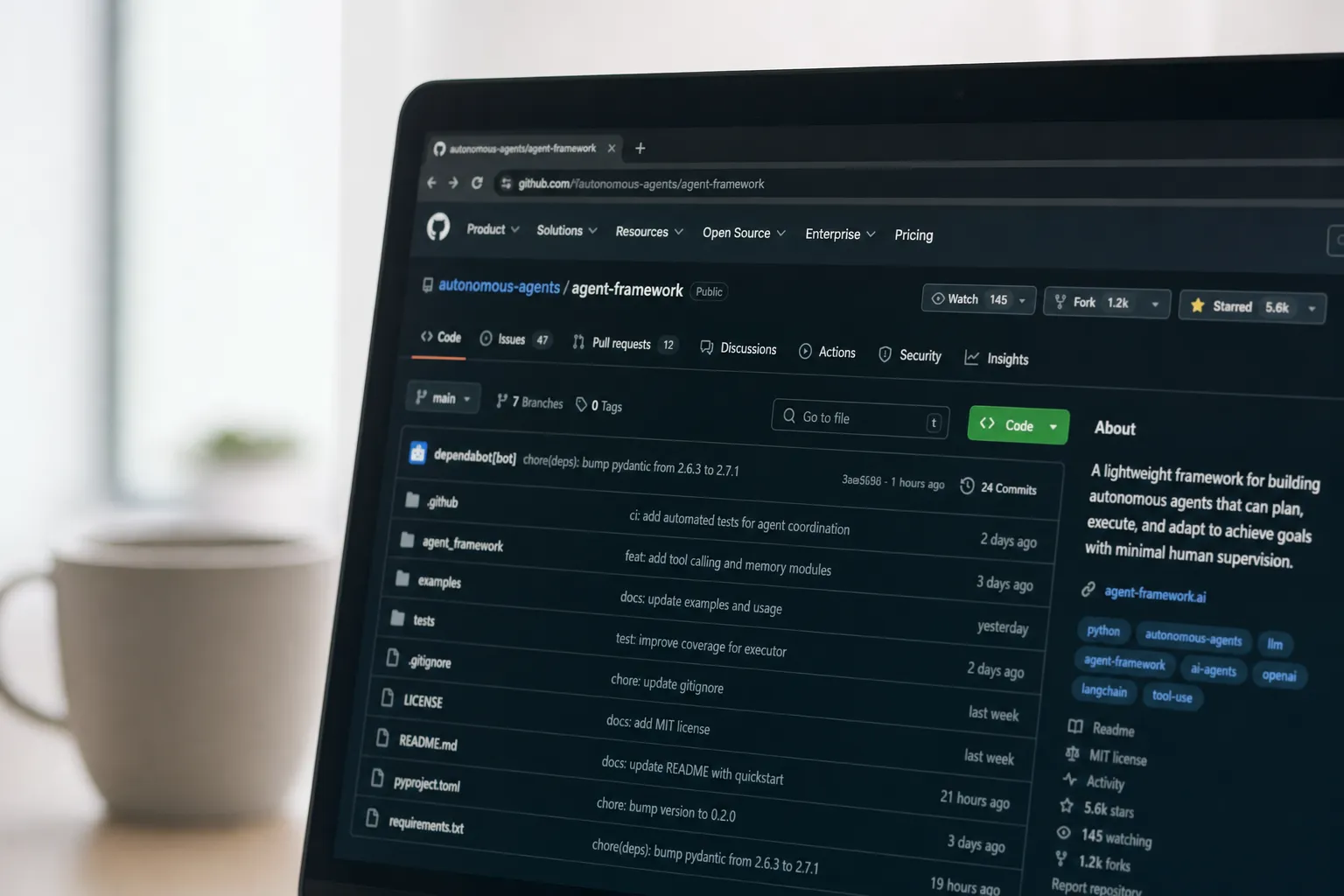
GitHub's trending repositories this week paint a sharp picture: developers are moving beyond AI assistants to build autonomous agents that run unsupervised in the background. KKKKhazix/agent-autoloop, created just two days ago, has already accumulated 3,027 stars with 1,397 stars gained daily—a velocity that signals genuine developer demand. The project's core promise is simple but powerful: create CLI agents that handle routine tasks autonomously, escalate edge cases to humans via notification cards when uncertain, and resume without interruption. Built in TypeScript with support for Claude Code, Model Context Protocol (MCP), and event-driven workflows, agent-autoloop represents a practical shift from "AI copilot" (human asks, AI responds) to "autonomous agent" (AI acts, human approves exceptions). A concrete use case: a developer might configure an agent to monitor repository issues, triage them by label and severity, open related PRs for documentation bugs, and page the developer only when a critical issue requires domain judgment—reducing daily interrupt noise while ensuring nothing falls through cracks.
This architectural pattern isn't isolated. Jakeschincariol/day-trader-skill (5,428 stars) and patch-gg/pixelfx (5,075 stars) show developers are investing in pre-built "skills"—reusable modules that extend agent capabilities without writing logic from scratch. The day-trading skill bundle includes backtesting, charting, news monitoring, and entry-exit timing; pixelfx bundles 244 pixel art effects plus a Claude Code plugin for custom effects. Why skills over building agents from zero? Pre-built skills compress iteration cycles—developers gain battle-tested, composable components rather than debugging agent control flow, error handling, and multi-tool orchestration themselves. Claude's dominance in this ecosystem stems partly from MCP (Model Context Protocol) adoption and context-window depth, enabling agents to maintain state across longer task chains without losing task context or hallucinating previous instructions.
Yet the explosion of agent frameworks also exposes risk. Unsupervised agents can cascade failures when escalation logic fails or when a task's "uncertainty threshold" miscalibrates—an autonomous trading agent that misinterprets a market halt, or a background agent that over-aggressively auto-merges PRs. The benjitaylor/skills and agent-autoloop communities will likely converge on standardized "breakglass" mechanisms: action replay before commit, dry-run previews, and role-based approval gates. GitHub's threat landscape—recently highlighted by supply-chain attacks exploiting repo issues—adds urgency; agents with write access must authenticate strictly and log all mutations. The trajectory is clear: autonomous agents are moving from research curiosity to production infrastructure. Developers starving these repositories aren't asking whether AI can help them; they're building the systems that will.