
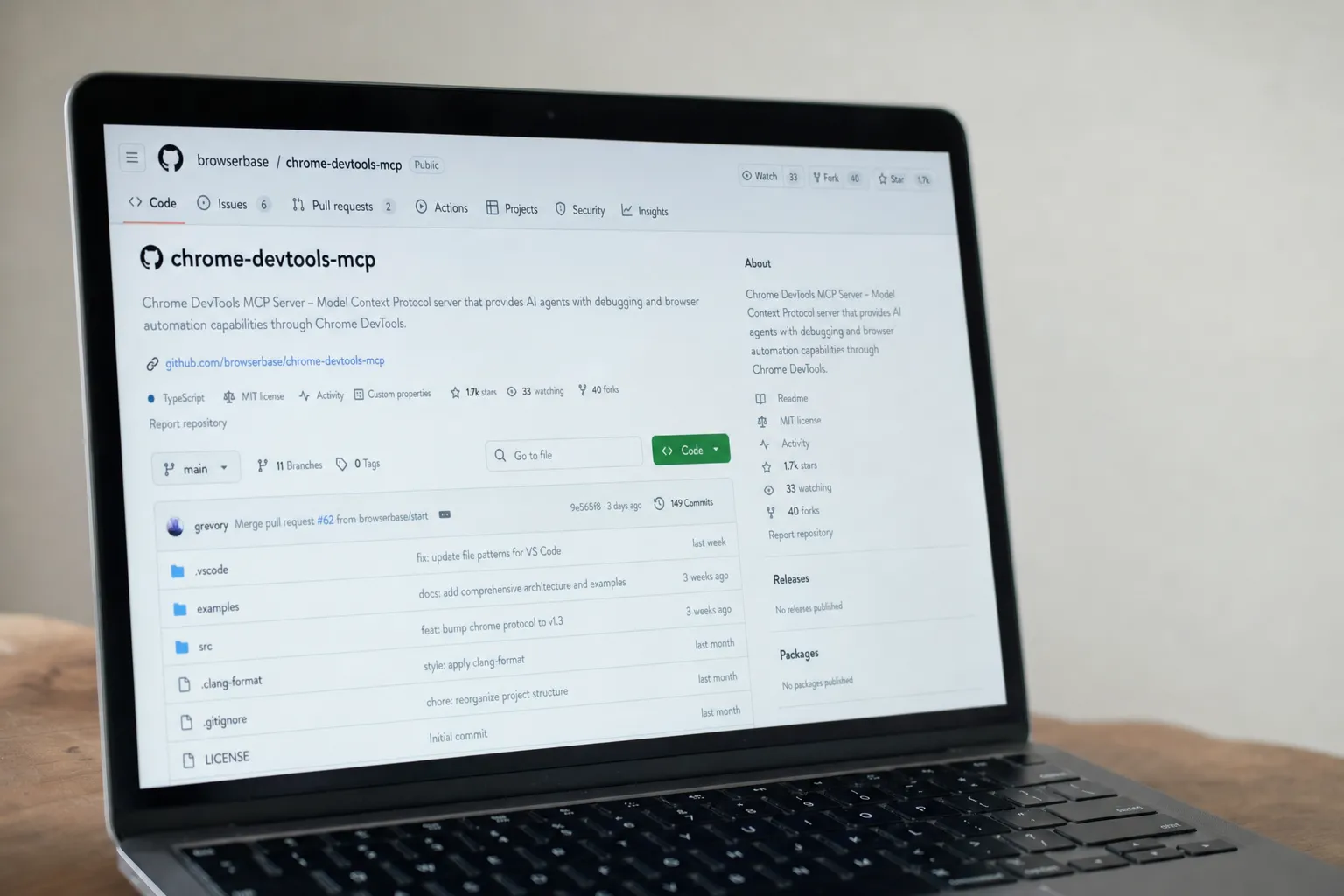
Chrome DevTools MCP topped GitHub's trending charts today, gaining 673 stars and signaling a maturing infrastructure layer for AI coding agents. The Model Context Protocol server exposes Chrome's debugging engine—network monitoring, DOM inspection, JavaScript console, runtime inspection, and screenshot capture—to Claude and other AI models through a standardized integration point. Unlike generic web browsing capabilities, this allows agents to programmatically inspect and manipulate web applications exactly as developers would: they see actual network requests in real-time, traverse CSS hierarchies, inspect JavaScript object state, and capture visual renderings of the DOM. An agent troubleshooting a broken web feature can now examine network waterfall charts to identify slow API endpoints, inspect the JavaScript console for runtime errors, and correlate visual screenshots with underlying code state. This transforms debugging from visual guessing into structured data analysis that agents can potentially reason about systematically.
Yet Chrome DevTools MCP does not exist in isolation. Today's surge reflects a broader developer pattern: trading-specific agent tooling gained 556 stars, network utilities like Tailcat climbed 490, and educational resources around AI engineering sustain 327 stars daily. Meta's recent open-sourcing of a design system explicitly built to be agent-friendly reinforces the message. Developers are not passively waiting for general AI capability improvements or hoping model scaling will eventually solve their problems. Instead, they are actively building specialized tool layers—debugging infrastructure, domain APIs, design systems, and market data connectors—that agents can actually call and interpret effectively. This is not vague enthusiasm about agents; it is pragmatic tooling construction aimed at giving AI systems access to infrastructure they can meaningfully use in specific domains rather than relying on abstract capabilities.
Yet significant gaps remain between tool access and actual problem-solving capability. Having Chrome DevTools available does not teach agents to reason about performance problems, cascading system failures, or architectural mistakes. Tools are raw infrastructure; they do not confer judgment. An agent with DevTools access might execute network requests and log responses, but reasoning about why third-party API integrations perform poorly, why CSS causes layout thrashing, or why caching strategies fail in production still requires deep domain knowledge and iterative testing that AI agents struggle with autonomously. Chrome DevTools MCP might enable faster debugging workflows and better visibility into system state, but it cannot substitute for the human expertise needed to interpret complex systems and make sound architectural decisions. The critical question is whether these multiplying integrations represent genuine capability unlocks or whether developers are building sophisticated infrastructure for AI systems that still lack the reasoning depth to use it effectively.