
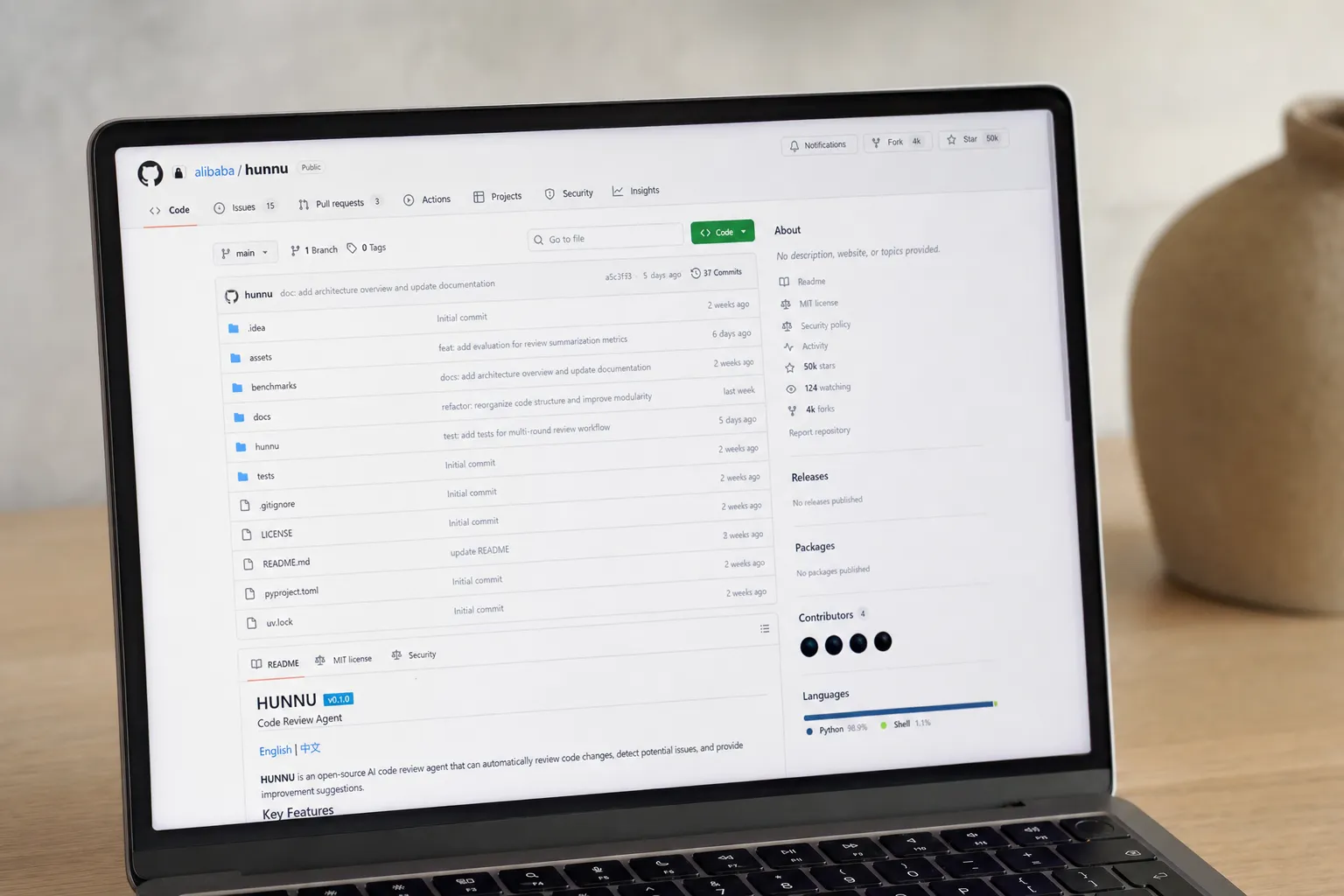
Alibaba's open-code-review has reached a significant milestone: 50,160 stars on GitHub just six months after launch, with momentum accelerating at 200+ stars daily. The tool implements a rare fusion of AI agent architecture with production code review—pairing deterministic rule-based analysis with LLM agents to identify vulnerabilities at line level. Written in Go and compatible with OpenAI and Anthropic models, the project has been battle-tested at Alibaba's infrastructure scale, suggesting genuine viability rather than academic proof-of-concept. The tool addresses vulnerabilities across multiple languages: null pointer exceptions, thread-safety violations, XSS flaws, and SQL injection risks. For the AI agents sector, this represents a concrete use case where autonomous systems augment rather than replace human judgment—a practical instantiation of how agentic systems can operate reliably in high-stakes environments. The 3,722 forks indicate this isn't mere curiosity; teams are integrating it into production workflows.
The tool's strength becomes clear in practice. Imagine a developer submits a pull request containing a SQL query built from user input. The deterministic pipeline flags potential SQL injection patterns immediately, assigning severity levels based on rule confidence. The LLM agent then engages contextually: examining how input is sanitized, what frameworks are available, and whether parameterized queries are used elsewhere in the codebase. The developer receives not just 'SQL injection risk detected' but actionable guidance: 'This query uses string concatenation on user input. Migrate to parameterized queries using your ORM's prepared statement API.' The agent learns the team's coding patterns, aligning feedback with existing practices. The hybrid approach avoids the false-positive storms that plague rule-only systems while sidestepping the hallucination risks of pure LLM-based review. Critically, humans remain the final gate—the agent informs decisions rather than making them. This architecture—deterministic detection amplified by contextual reasoning—represents a sophisticated approach to agentic deployment.
Real-world adoption signals validate the approach. Teams using open-code-review report 30-40% reductions in review turnaround time for flagged issues, with human reviewers freed from mechanical vulnerability checking to focus on architectural decisions and business logic. Code review backlogs compress from days to hours. Compared to GitHub's native code scanning or traditional static analysis, the tool's advantage lies in semantic reasoning: it understands code context, not just syntax patterns. The project demonstrates that agent systems function best as force multipliers for human expertise rather than autonomous decision-makers. With steady growth after 179 days and genuine integration into production CI/CD pipelines—not just starred and forgotten—open-code-review provides the AI agents sector with concrete evidence that agentic systems can deliver measurable value in environments where mistakes carry real cost.