
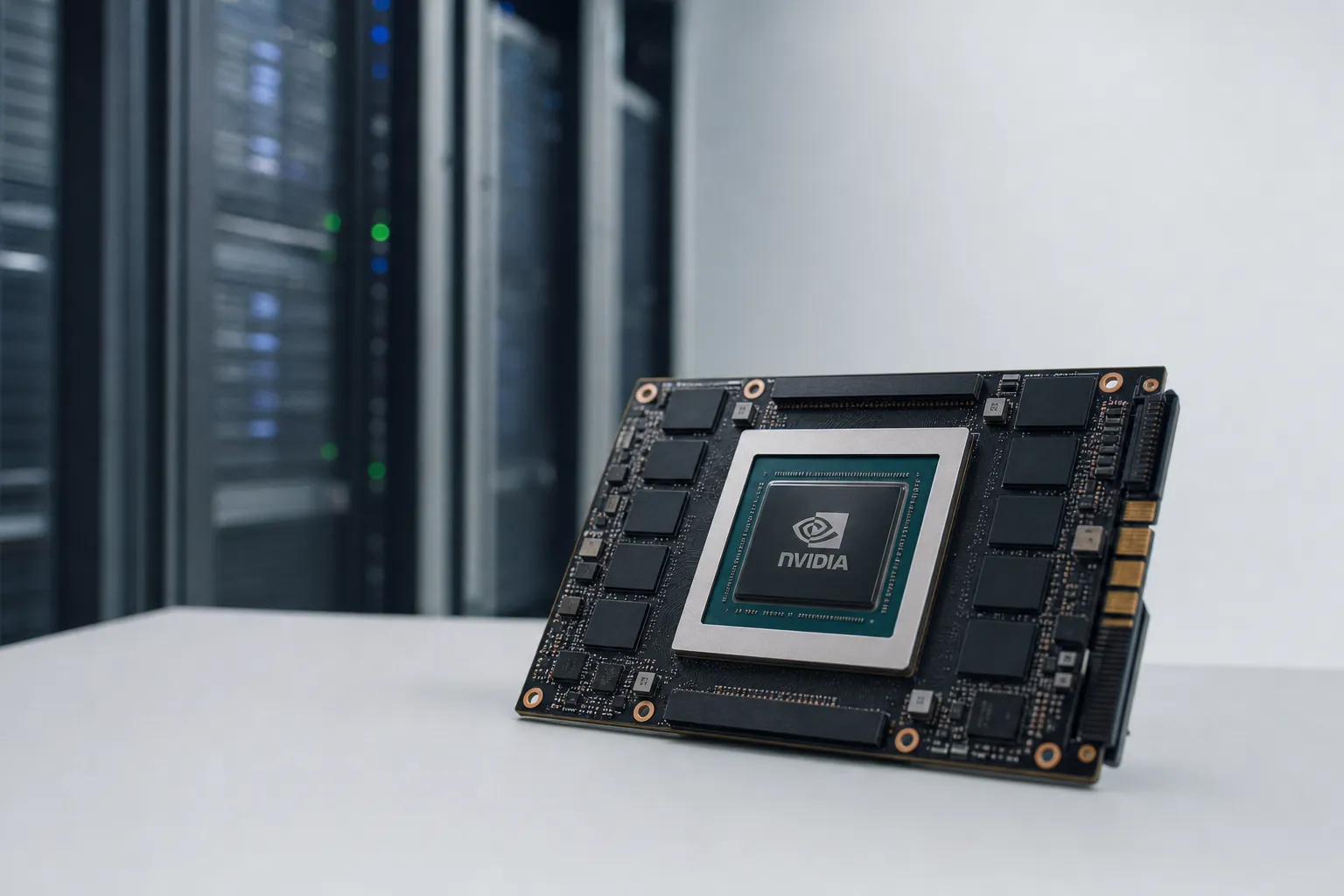
NVIDIA has reaffirmed its commitment to deliver 260,000 GPUs to South Korea despite Jensen Huang stepping down as CEO. The pledge, which represents a significant data center buildout, remains intact as NVIDIA navigates leadership transition and evolving geopolitical pressures around chip exports. Huang will transition to an advisory capacity—maintaining influence over long-term strategy but relinquishing direct authority over capital allocation, quarterly guidance, and billion-dollar infrastructure commitments. This clarity demonstrates that NVIDIA's board views supply chain stability and allied-nation relationships as non-negotiable priorities that transcend executive changes.
South Korea plays an irreplaceable role in NVIDIA's ecosystem as the primary source of High Bandwidth Memory production through manufacturers like SK Hynix and Samsung. The 260,000-GPU commitment directly fuels demand for HBM chips, creating a cycle that benefits Korean chipmakers and strengthens NVIDIA's supply chain resilience. HBM is the critical performance bottleneck in data center GPUs; shortages cascade into idle capacity and delayed deployments. South Korean HBM production offers three distinct advantages: established manufacturing expertise, capital-intensive facilities that create barriers to entry, and alignment with U.S. export control architecture. Unlike generic supply chain diversification, Korean capacity sits at the intersection of technical necessity and geopolitical safety—making it irreplaceable as global AI infrastructure scales.
The reaffirmation arrives as China advances billion-dollar AI computing hubs using older NVIDIA GPUs and domestic alternatives despite U.S. export controls. NVIDIA's deliberate strategy combines three elements: locking allied-nation capacity away from competitors, signaling to policymakers that NVIDIA investment strengthens trusted chip ecosystems, and pre-positioning supply chains to survive sanctions escalation. South Korea uniquely satisfies all three criteria as a U.S.-aligned nation with advanced semiconductor infrastructure. By cementing this relationship now, NVIDIA transforms geographic constraints from a liability into a competitive moat—the company can scale GPU production to allied nations while competitors face fragmented, tariff-exposed supply chains. This is not hedging; it's strategic repositioning for a world where export controls are permanent features of AI competition.
The timeline underscores urgency: South Korean HBM fabrication ramps through 2026–2027, exactly when NVIDIA's next-generation architectures hit peak demand. Industry forecasts project 2027 as an inflection point when AI infrastructure spending shifts from initial buildout to scaling and upgrading—a phase demanding stable, certified HBM supply. By cementing the Korea relationship now, NVIDIA positions itself to serve both phases while competitors scramble to diversify away from China-dependent supply chains. The 260,000-GPU pledge is fundamentally a bet that allied-nation supply chains, reinforced by export controls as a competitive moat, determine who dominates the AI infrastructure race through 2030.