
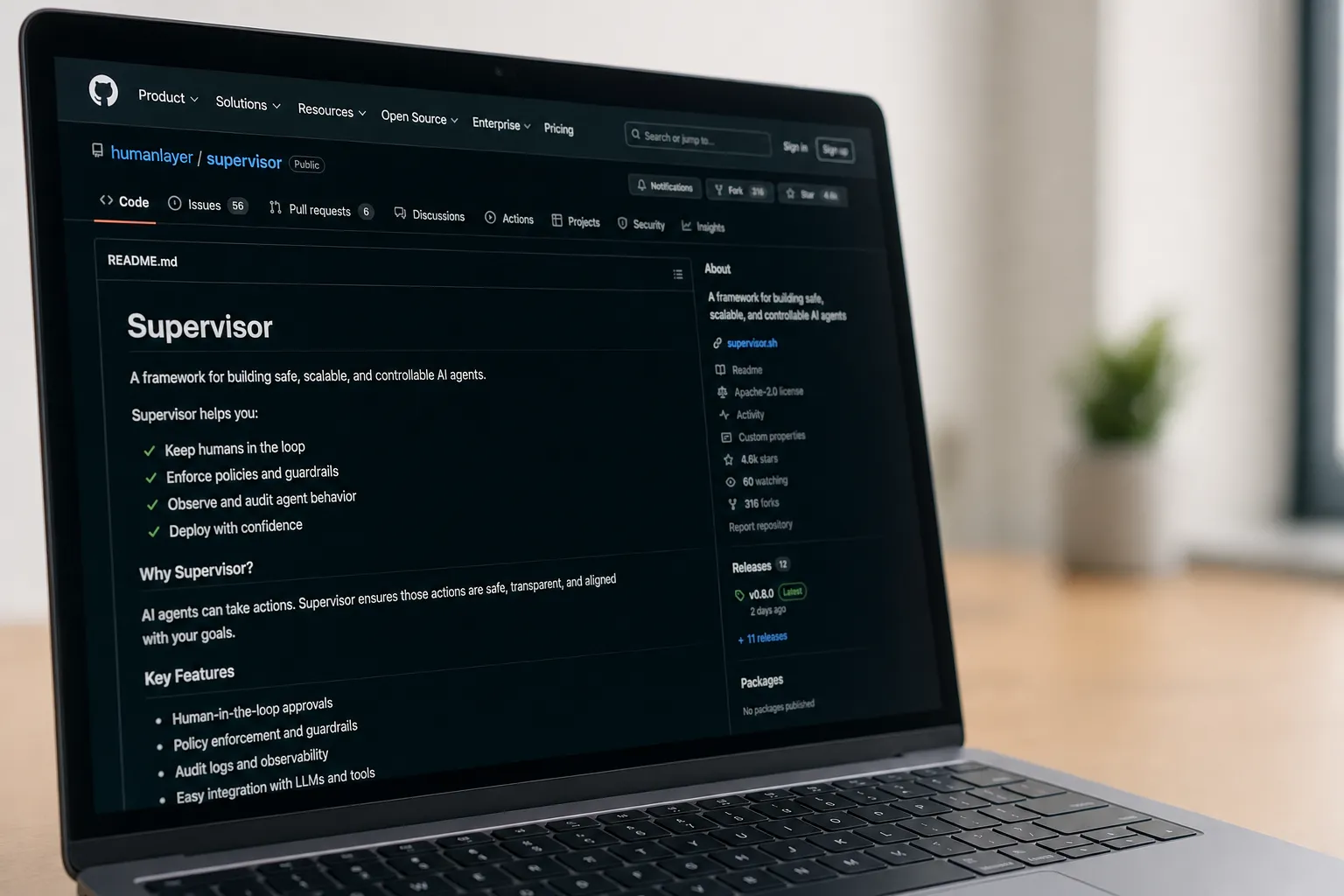
GitHub's trending repositories this week send a clear signal: developers are aggressively adopting AI agent tools that hand over device control while keeping humans in the loop. DIYgod/pinky, launched just three days ago, has rocketed to 1,259 stars with a 450-star daily burn rate, making it one of the fastest-growing projects in AI tooling. The project solves a concrete problem—enabling AI agents to autonomously interact with phones and applications while maintaining human oversight—and its velocity suggests urgent, real demand from developers. This surge reflects fundamental maturation in agent architecture: the field is moving beyond pure automation toward human-in-the-loop systems that preserve control, auditability, and safety in production deployments. For teams integrating AI into real applications, the message is clear: agents that operate with meaningful human intervention are no longer theoretical.
Parallel momentum spans multiple specialized domains. JuneYaooo/rea-video hit 5,096 stars in 11 days, growing 471 stars daily, enabling agents to analyze videos frame-by-frame and classify whether footage is filmed, AI-generated, or procedurally created. Its integration with Claude Code signals agent tooling expanding into multimodal domains. Two competing Nintendo Switch 2 emulators—Lichii (7,175 stars) and Eglantine (5,520 stars)—crossed 7,000+ stars each in under two weeks. Google DeepMind's MuJoCo physics simulator added 579 stars today. This breadth across device automation, media analysis, emulation, and robotics indicates developers are building specialized agent infrastructure rather than consolidating around a single framework, suggesting an early-stage market diverging by use case and domain.
Clear technical enablers explain this surge. Claude's code execution and agentic reasoning capabilities have matured from experimental to production-reliable for precise device control and real-world decision-making. Open-source improvements—containerization, API standardization, and frameworks like the Claude SDK—have dramatically lowered barriers to entry for developers building agents. Organizationally, demand for human-in-the-loop agents has shifted: companies increasingly recognize that autonomous systems with meaningful human oversight checkpoints are deployable and trustworthy in production, reversing institutional resistance to agent architectures. The result is a positive feedback loop: better models enable better agents, better open frameworks democratize development, and legitimate production demand validates the approach. Developers have collectively moved from asking 'Can agents do this?' to 'How do we deploy agents safely in production?'
GitHub's trending data this week crystallizes an inflection point. Agent tooling has graduated from research experiment to core infrastructure, with multiple projects gaining mindshare across specialized domains rather than consolidating. For developers building AI applications, the signal is unambiguous: the community has moved decisively from experimentation to infrastructure. The ecosystem's divergence by use case—phones, media, robotics, emulation—mirrors earlier infrastructure booms where domain specialization precedes framework consolidation, suggesting significant room for specialized builders to gain traction.
The pattern emerging across GitHub trending indicates the agent infrastructure market is stratifying by use case rather than centralizing around a general-purpose framework. If your product or workflow involves automating complex systems, analyzing content at scale, or controlling devices remotely, agent tools are now production-ready—not speculation. The 'agent era' on GitHub isn't approaching; it's already distributing across the developer ecosystem, one domain and use case at a time.