
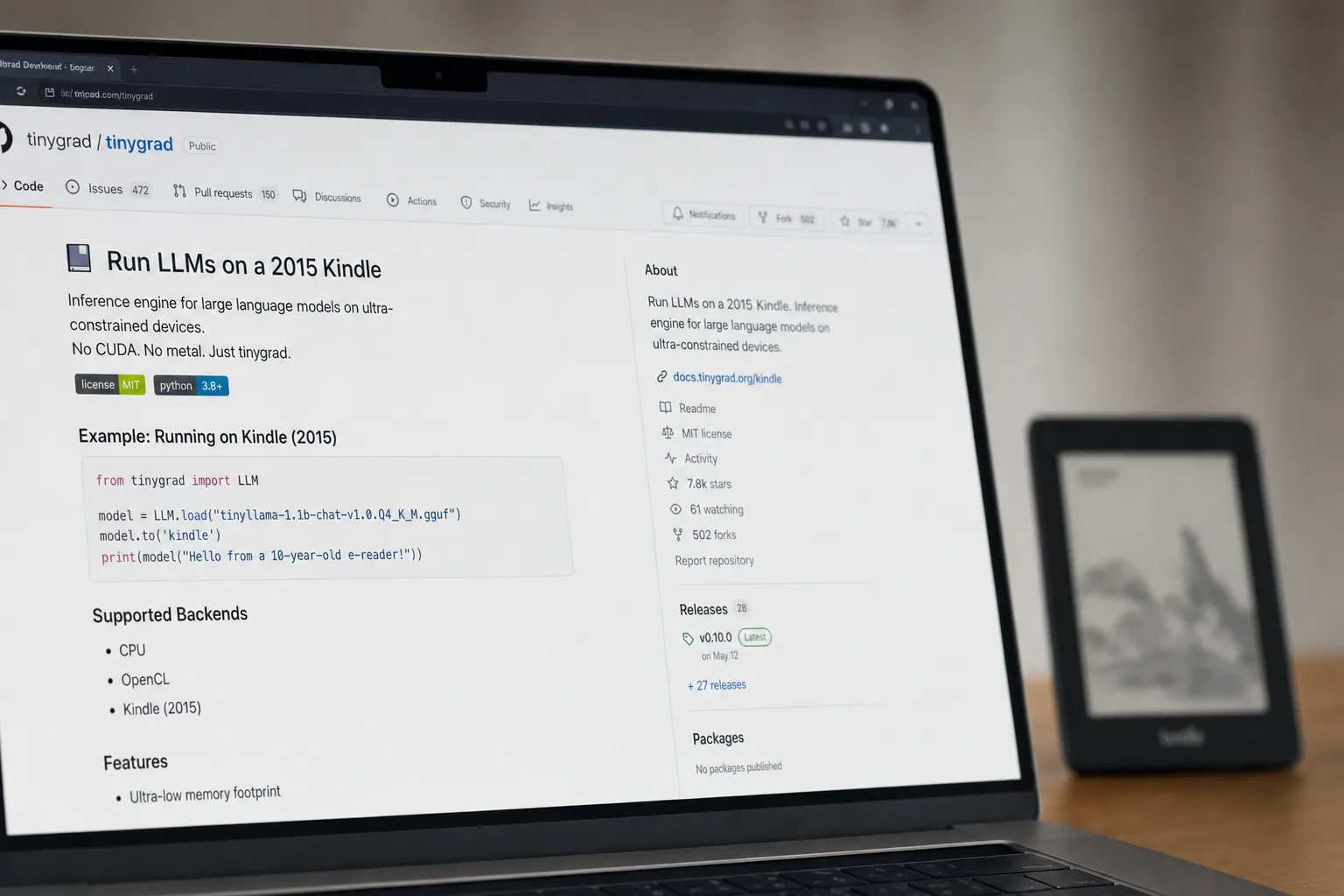
A developer successfully ran a language model on a 2015 Kindle Paperwhite, demonstrating how far open-source model optimization has advanced. While performance on the e-reader's minimal hardware—512MB of RAM and a 1GHz processor—is predictably slow, the feat showcases the maturity of the open-source AI ecosystem. This builds on momentum around tools like Ollama and llama.cpp, which have made local inference increasingly accessible. Quantization and pruning techniques have evolved enough to enable language model execution on devices never designed for AI workloads.
The significance lies in validating years of open-source investment in efficiency. Model optimization has reached a point where even a decade-old e-reader can host functional language models. This represents a fundamental shift in open-source AI development: as techniques improve, hardware requirements shrink. What previously demanded dedicated GPUs or high-end processors can now run on consumer devices with minimal compute. For developers pursuing edge AI and local inference, this signals substantial headroom for deploying models on embedded systems, older phones, and IoT hardware—expanding feasibility without cloud dependencies.
The broader implications extend beyond the Kindle itself. As open-source tools continue advancing, we're witnessing the expanding frontier of practical local deployment. Projects like llama.cpp and GGML, focusing on model compression and efficient inference, are pushing AI capability deeper into hardware constraints most developers actually work with. This democratization of local inference—running AI without cloud dependencies on whatever devices people already own—advances the core mission of accessible, self-hosted AI. The open-source ecosystem's focus on efficiency isn't just enabling novelty; it's reshaping where language models can realistically be deployed.