
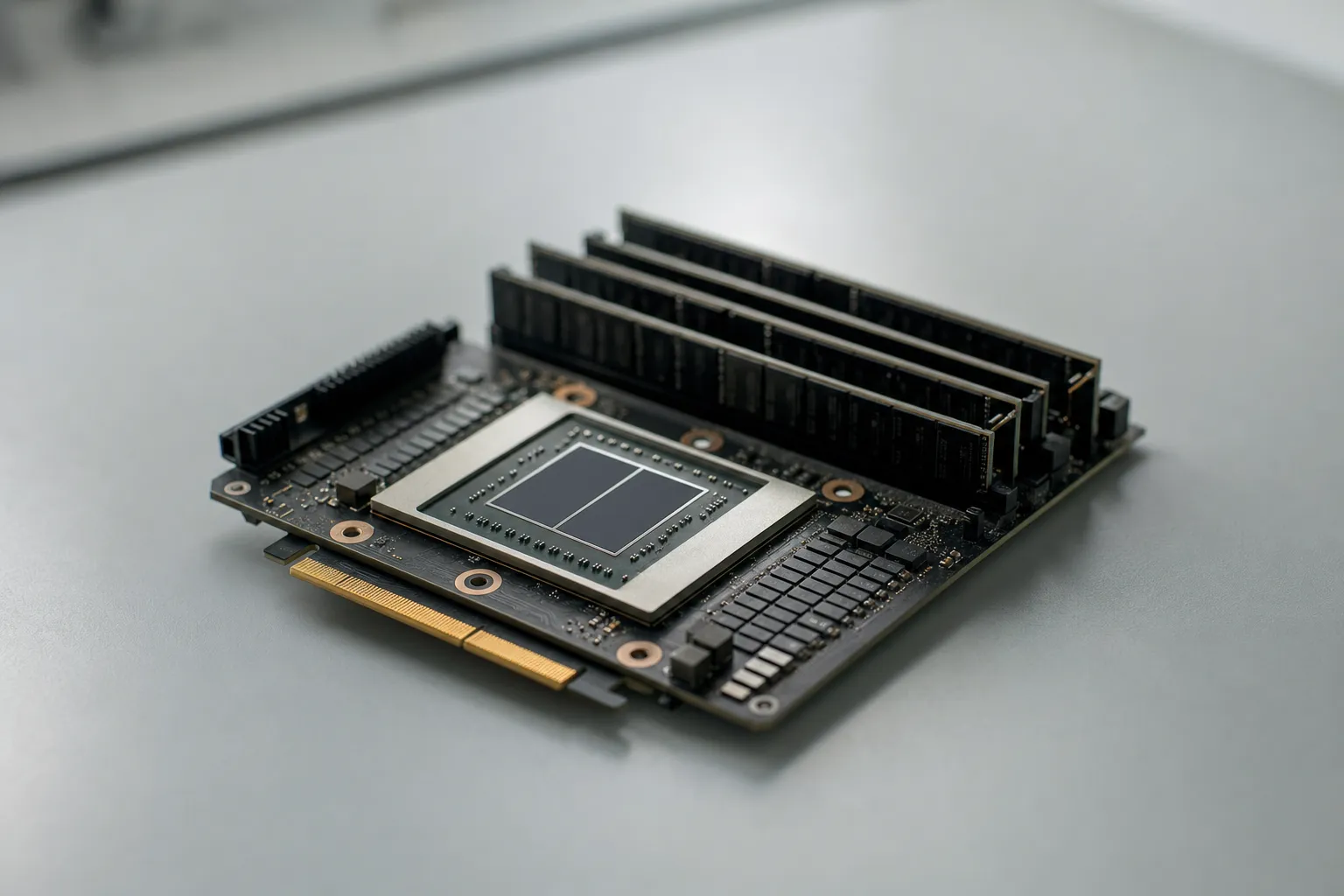
The AI infrastructure world is facing an unwelcome reality: GPU compute power has outpaced memory capacity, creating a bottleneck that threatens to stall deployment even as the industry expands capacity. As models grow larger and agentic applications become more complex—requiring constant movement between GPU reasoning and CPU execution—memory pressure has intensified. Industry developments show that larger models, longer context windows, and emerging agent workloads that search databases, write code, and iterate through execution loops are dramatically increasing memory requirements. Meanwhile, GPU memory supply remains constrained, with prices rising through the near term. This creates a compounding problem: enterprises deploying cutting-edge models face both technical challenges in fitting workloads into available memory and economic pressures from rising costs per unit of usable compute capacity.
NVIDIA's response has centered on partnering with memory manufacturers to rapidly adopt the latest memory technologies. The company has positioned itself as first-to-market with newer memory architectures designed to improve throughput and efficiency. However, these incremental improvements confront a fundamental systems problem: memory bandwidth has historically grown slower than compute performance—a constraint known in computer architecture as the 'memory wall.' Even optimized systems have inherent limits that no single technology partner can overcome. The industry is exploring alternatives: distributing agent workloads across CPU and GPU infrastructure to reduce peak memory pressure, aggressively optimizing models through quantization and pruning to fit within existing constraints, and redesigning applications to tolerate latency from distributed computing. These represent pragmatic workarounds rather than solutions to the underlying architectural imbalance.
The memory crunch illustrates a broader inflection point in AI infrastructure: the era of scaling through raw compute and storage is hitting physical and economic limits. Hard choices loom about architectural tradeoffs—accepting higher latency through distributed systems, tolerating lower model quality through compression, or paying sharply rising costs for high-memory specialized systems. For now, memory optimization remains a critical but underdiscussed priority compared to the hunt for GPU throughput, despite increasingly determining what's actually deployable in production systems. As AI workloads move from research prototypes to operational agents making real-world decisions, the memory constraint will become less a technical curiosity and more a hard business reality.