
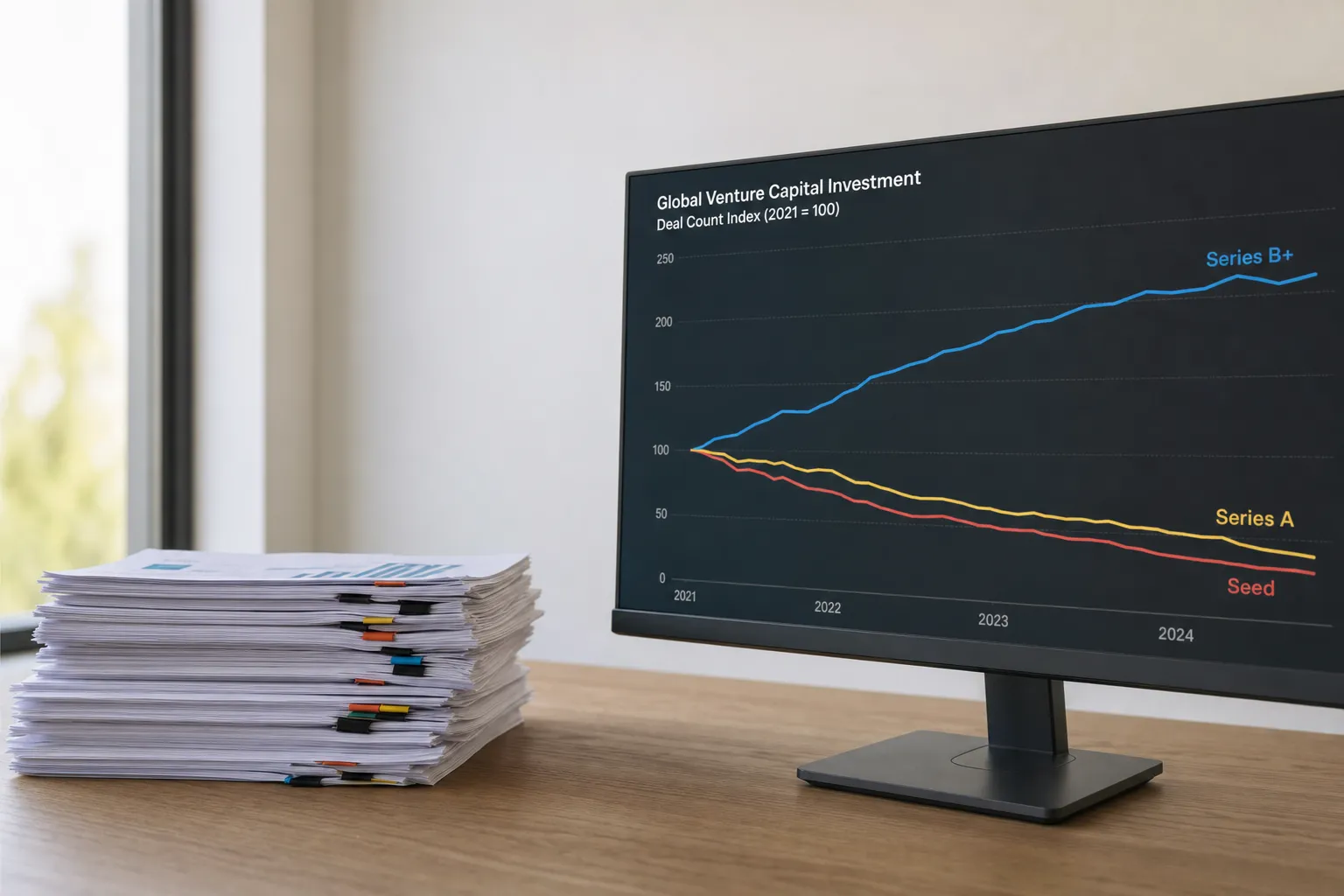
The venture capital landscape is experiencing a stunning bifurcation. While Series B financings have attracted approximately $48 billion so far this year—the highest tally in years—the deal count at that stage remains below year-ago levels and is tracking toward a multiyear low, according to Crunchbase data. This paradox points to a brutal concentration of capital: megafunds are backing fewer, larger bets, leaving the broader seed and Series A ecosystem starved of attention. The week's funding leaderboard exemplified this trend, with manufacturing AI startup Re:Build closing a $2.1 billion round and predictions marketplace Kalshi adding another $1 billion. These outsized checks increasingly represent the bulk of available capital, obscuring a gutting reality for founders earlier in their journey. Seed-stage deal counts have contracted sharply from 2024 levels, and Series A rounds—historically the bridge between proof-of-concept and scale—are experiencing similarly depressed activity, despite the sector's continued rhetoric around democratizing AI.
Seed founders are now confronting markedly higher bars to clear. Investors previously willing to fund teams with compelling ideas and modest traction now demand measurable revenue metrics, demonstrated product-market fit signals, and extended cash runways before cutting checks. Marc Schröder, a partner at MGV, advocates that founders should explicitly structure seed rounds around Series A milestones rather than 18-month survival. This represents a fundamental shift: seed investors are de facto requiring founders to solve problems that were traditionally Series A concerns. The compressed timeline creates a catch-22: without adequate early capital, founders cannot hit the metrics Series A investors now demand; without hitting those metrics, Series A capital dries up further. This dynamic is particularly acute in capital-intensive verticals like travel tech, where AI-driven optimizations have failed to reverse a multiyear funding slowdown despite sustained travel demand. Several travel logistics startups have quietly extended fundraising timelines or reduced scope, unable to secure Series A commitments that would have closed 18 months ago.
The underlying driver appears structural rather than cyclical. Limited partners are reportedly shifting allocation away from early-stage venture vehicles altogether, preferring the perceived safety of mega-rounds backed by established VCs with proven track records in AI. This LP preference is reshaping the entire funnel: fewer seed funds are being raised, fewer Series A vehicles are deploying capital, and capital that does exist gravitates toward companies already demonstrating significant revenue or user traction. The 127,000-plus tech layoffs spanning 2025 into 2026 may paradoxically worsen conditions, as displaced talent floods the founder pipeline while capital availability contracts. For the seed ecosystem, this represents not a temporary correction but a potentially structural realignment where only the most capital-efficient, revenue-generating early-stage companies will attract investment. The message to founders is unambiguous: arrive at your seed round further along than ever before, or risk an extended drought.