
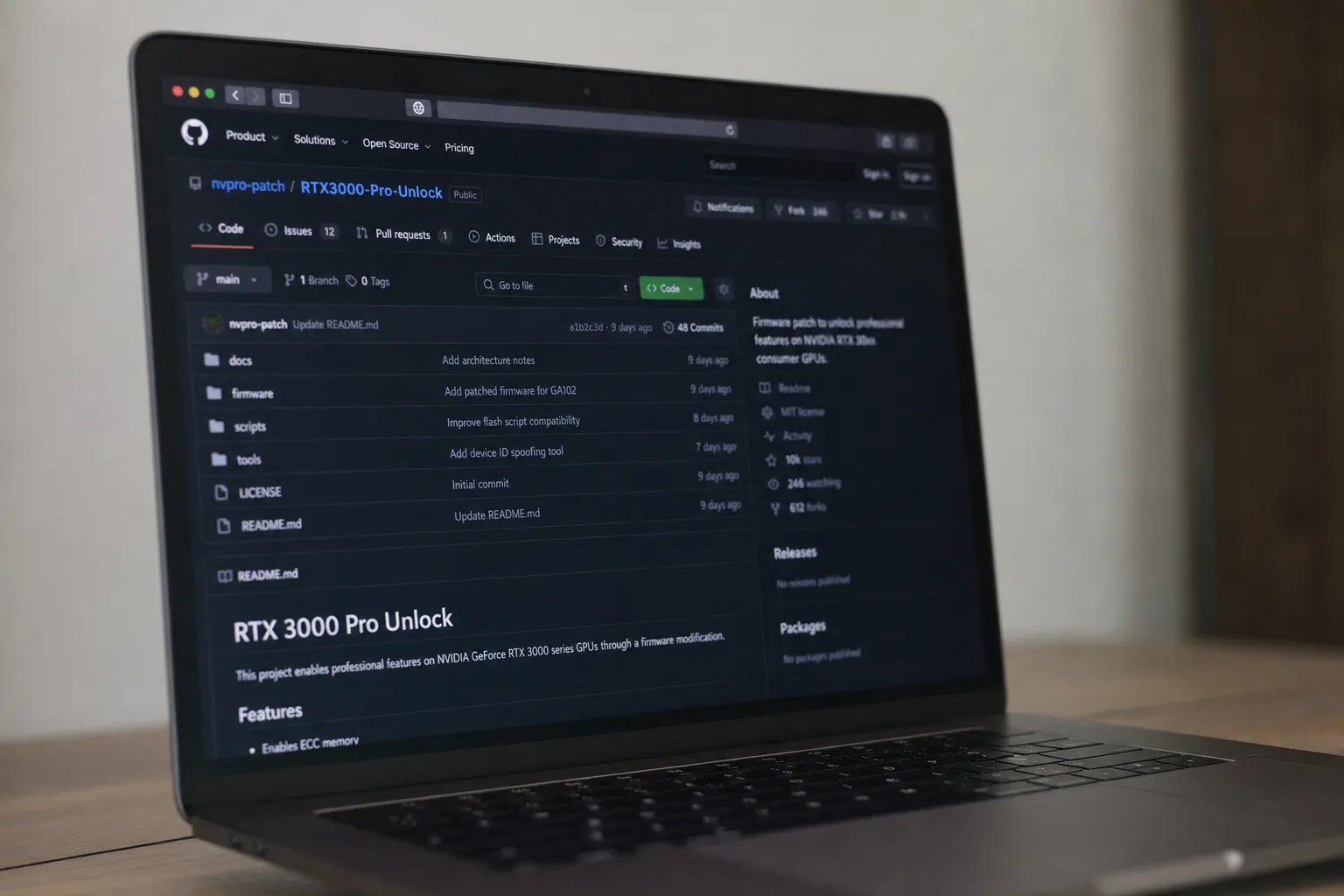
Zagitta's gpu-unlock project has become a phenomenon, accumulating over 10,594 stars and 1,047 forks since launch on October 18th, with 1,127 stars added daily. The tool exploits a firmware-level mechanism to unlock FP16 and BF16 instruction throughput on Nvidia's RTX 3000-series consumer GPUs, enabling them to match the performance profile of Nvidia's A100 and H100 professional cards—which sell at 10x the price. Written in C and gaining traction on Hacker News, the project reveals a developer community acutely frustrated with Nvidia's artificial performance segmentation. The unlock works by modifying GPU firmware, a technical approach that sits in a legal gray area: it violates no laws per se, but potentially breaches Nvidia's terms of service and may contravene the DMCA if Nvidia chooses to litigate.
The technical mechanism is straightforward but profound in implication. Nvidia artificially throttles tensor operations on consumer-grade hardware through firmware constraints, not silicon differences—the RTX 3090 and A100 are functionally identical in raw computational capacity. By patching the firmware, gpu-unlock removes these throttles, letting researchers, startups, and cost-conscious AI teams access professional-grade inference performance for a fraction of the cost. This strikes at Nvidia's core pricing strategy: market segmentation relies on artificial scarcity and gatekeeping. The timing coincides with broader developer backlash against restrictive licensing (visible in ThinkRail's 1,173-star surge today as an open-source IDE alternative to proprietary tools) and growing price sensitivity in AI infrastructure—startups are increasingly questioning whether they should pay Nvidia's professional GPU premium or find workarounds.
The critical question now is whether Nvidia will patch this vulnerability or tacitly tolerate it as a pressure relief valve. Patching invites regulatory scrutiny and developer backlash; ignoring it risks revenue erosion from A100/H100 sales to budget-conscious users. History suggests Nvidia will pursue incremental enforcement—releasing firmware updates while avoiding public confrontation. What gpu-unlock signals is not a technical surprise (firmware unlocking is decades old) but a sociological one: developers are now coordinated enough, frustrated enough, and organized enough through GitHub to rapidly commoditize Nvidia's artificial constraints. If 10,000 stars in nine days becomes the new baseline for developer-led circumvention projects, Nvidia's pricing model faces structural pressure.