
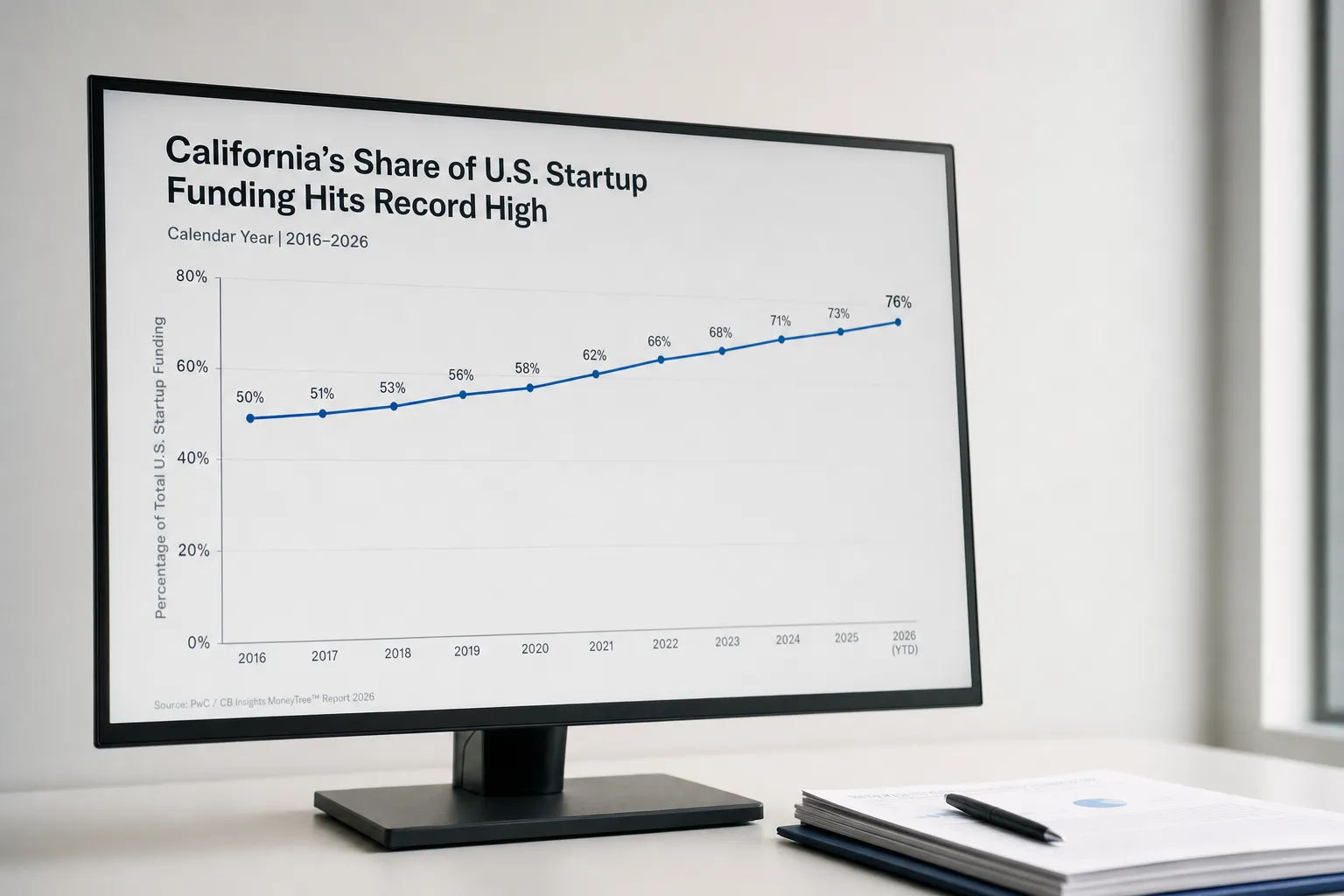
California startups have secured more than 76 percent of all U.S. venture funding through late 2026, according to Crunchbase analysis, marking an apparent all-time high concentration in a single state. The figure is particularly striking because the year still has weeks remaining, meaning California's final share could climb even higher. This eclipses the previous record for total U.S. startup funding in any single calendar year, underscoring how dramatically capital has consolidated on the West Coast. The surge comes amid an intense competition for AI infrastructure plays, with major rounds flowing to companies developing chips, processors, and AI systems that require substantial upfront capital to compete. Large financings for AI processor developer Tenstorrent and other infrastructure-focused startups have disproportionately benefited California-based companies with existing networks in Silicon Valley and access to limited partner capital.
The concentration reflects both the pull of existing AI talent hubs and the push of venture firms increasingly betting on proven ecosystems. Venture capital, by nature, clusters around successful exits and experienced founder networks, and California's dominance in generative AI has magnetized capital flows. Major firms from Iconiq Capital to Sapphire Ventures maintain concentrated LP bases and decision-making infrastructure on the coast, reducing friction for California deals. Meanwhile, the AI infrastructure boom—requiring deep technical expertise, proximity to GPU suppliers, and relationships with hyperscalers like OpenAI and Google—has tilted the playing field decisively westward. Regional venture firms and emerging hubs in cities like Austin, Miami, and Boston have struggled to compete for the largest mega-rounds, particularly in hardware and systems-level AI companies where capital requirements exceed $50 million.
The implications for non-coastal founders are material and troubling. Founders outside California face steeper Series A timelines, higher required traction thresholds, and lower valuations relative to West Coast peers building identical products. Regional venture funds have not expanded deployment capacity at pace with coastal competitors, meaning Series A terms outside California have compressed while coastal rounds expanded. A founder in the Midwest or Southeast seeking $10-15 million for an AI application startup now encounters VCs with smaller fund sizes and limited dry powder, forcing either relocation or acceptance of unfavorable economics. This geographic arbitrage in capital availability signals a structural challenge for the venture ecosystem: as AI becomes the dominant investment thesis, concentration in coastal hubs may accelerate, leaving regional innovation starved of growth capital and deepening the geographic stratification of American entrepreneurship.