
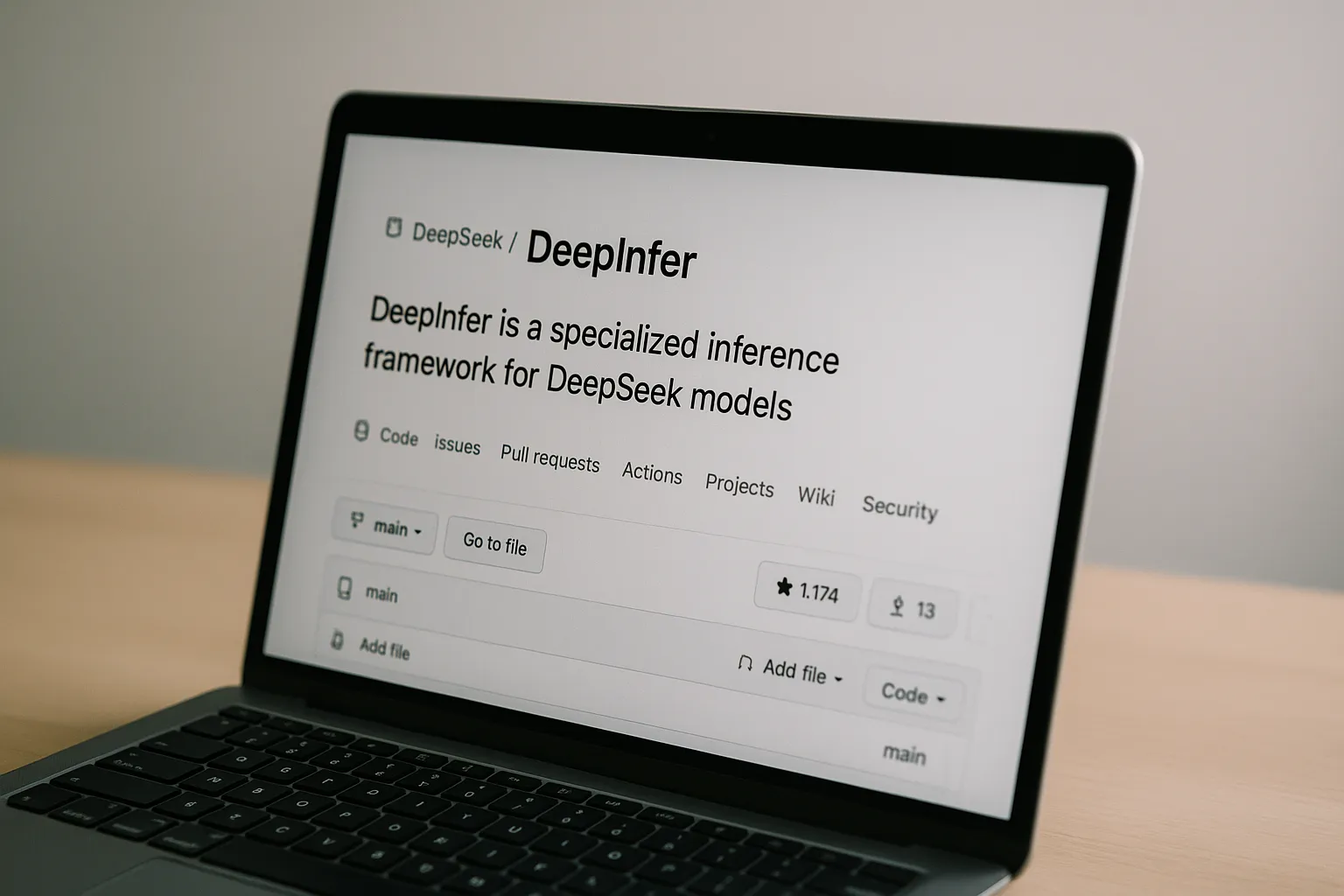
DeepInfer has rapidly emerged as a specialized inference framework designed specifically for DeepSeek models, accumulating 4,858 GitHub stars and 1,174 daily additions since its October 16 launch. While existing inference engines like vLLM and Text Generation Inference (TGI) serve as general-purpose solutions for LLM deployment, they were not architected with DeepSeek's unique model characteristics in mind. DeepInfer addresses this gap by implementing optimizations native to DeepSeek's architecture, including support for their MLA (Multi-head Latent Attention) mechanism and group query attention patterns. The framework tackles critical pain points in production deployments: reducing memory footprint during inference, accelerating token generation throughput, and improving batch processing efficiency at scale. Organizations running multi-instance DeepSeek deployments report meaningful latency improvements and reduced GPU memory pressure compared to generic frameworks, though specific benchmark data remains preliminary given the project's nascent stage.
Architecturally, DeepInfer diverges from one-size-fits-all inference engines by embedding DeepSeek-specific kernel optimizations directly into its execution layer. Rather than treating DeepSeek models as interchangeable with other architectures, the framework includes custom CUDA kernels for attention computation and specialized quantization support tailored to DeepSeek's training methodology. This targeted approach introduces trade-offs: while it delivers measurable performance gains for DeepSeek workloads, it sacrifices the flexibility of cross-model compatibility that frameworks like vLLM provide. For teams committed to the DeepSeek ecosystem—whether for cost optimization, inference speed, or downstream agent system integration—the architectural specialization represents a meaningful advantage. A concrete use case involves RAG (Retrieval-Augmented Generation) pipelines where token-per-second throughput directly impacts response latency; DeepInfer's optimizations enable real-time document retrieval and synthesis workflows at lower infrastructure cost.
What makes DeepInfer significant to the agent infrastructure landscape is its timeliness. As autonomous systems increasingly rely on fast, cost-effective inference for decision loops and reasoning chains, specialized frameworks reduce the operational overhead of deploying capable model backbones. DeepInfer currently delivers measurable wins in production scenarios: reduced per-token latency, better multi-GPU scaling characteristics, and lower memory overhead during inference. The Apache 2.0 licensed codebase is written in Python, maintaining accessibility for ML engineers while prioritizing performance-critical paths. For teams building AI agent systems that depend on fast inference cycles, DeepInfer represents a pragmatic alternative to retrofitting generic frameworks—it's engineered for what DeepSeek models actually do, not what they theoretically could do in a universal system.