
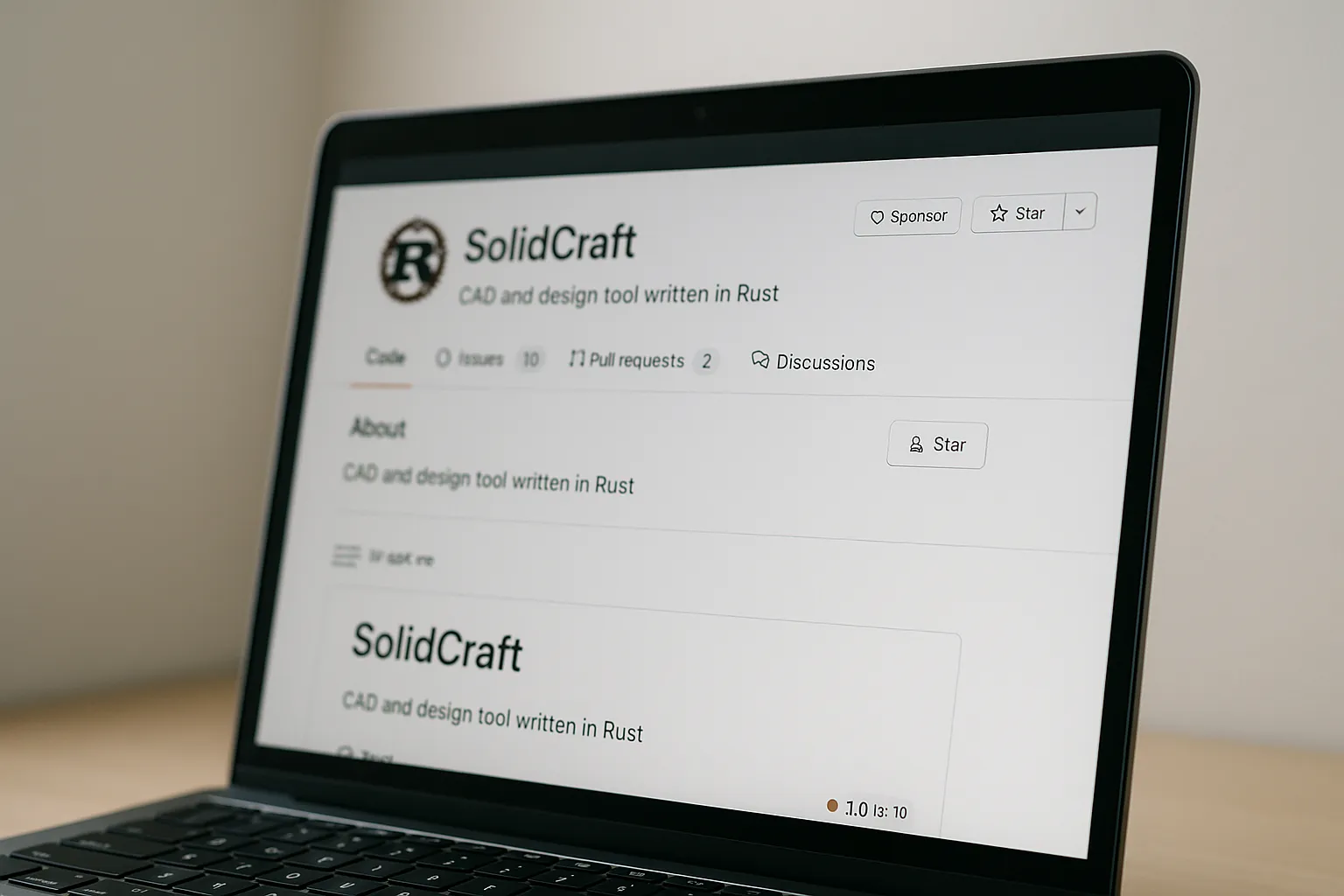
SolidCraft and DesignCraft, both pure-Rust implementations of traditionally heavy desktop applications, have become GitHub's fastest-trending repositories over the past two weeks. SolidCraft, a parametric 3D CAD platform launched October 7th, has accumulated 4,476 stars at a rate of 427 per day. DesignCraft, an open-source layout and page design editor, sits at 4,342 stars with 260 daily additions since its October 1st launch. Both projects dwarf typical trending repositories and suggest a fundamental reassessment of how developers approach professional-grade creative software. The timing is significant: these launches cluster within a 16-day window, indicating synchronized recognition of Rust's suitability for this space rather than isolated interest.
The developer community's enthusiasm reflects concrete technical advantages. Rust eliminates memory safety vulnerabilities endemic to C++-based CAD tools while delivering near-native performance without the overhead of Electron's Chromium runtime. SolidCraft's approach to shipping desktop, web, and automation layers through a single codebase via Model Context Protocol (MCP) addresses a pain point that has long fragmented professional software stacks. DesignCraft's rapid fork rate—2,997 forks against 4,342 stars, an unusually high ratio—indicates not passive admiration but active contributor intent. Both projects leverage egui (immediate-mode GUI framework) and Rust's ecosystem maturity for systems-level work, avoiding the traditional trade-off between development velocity and runtime efficiency.
This trend signals a generational shift in how developers prioritize infrastructure for computationally intensive applications. Legacy tools like AutoCAD and Fusion 360 remain incumbents, but their bloated footprints and licensing friction leave room for lean, open alternatives. The concentration of trending activity around Rust-native solutions—rather than incremental improvements to Electron or web-based alternatives—suggests the developer community has reached consensus: for tools demanding real-time rendering, complex geometry processing, and cross-platform deployment, Rust's guarantees and performance profile now outweigh the friction of its learning curve.