
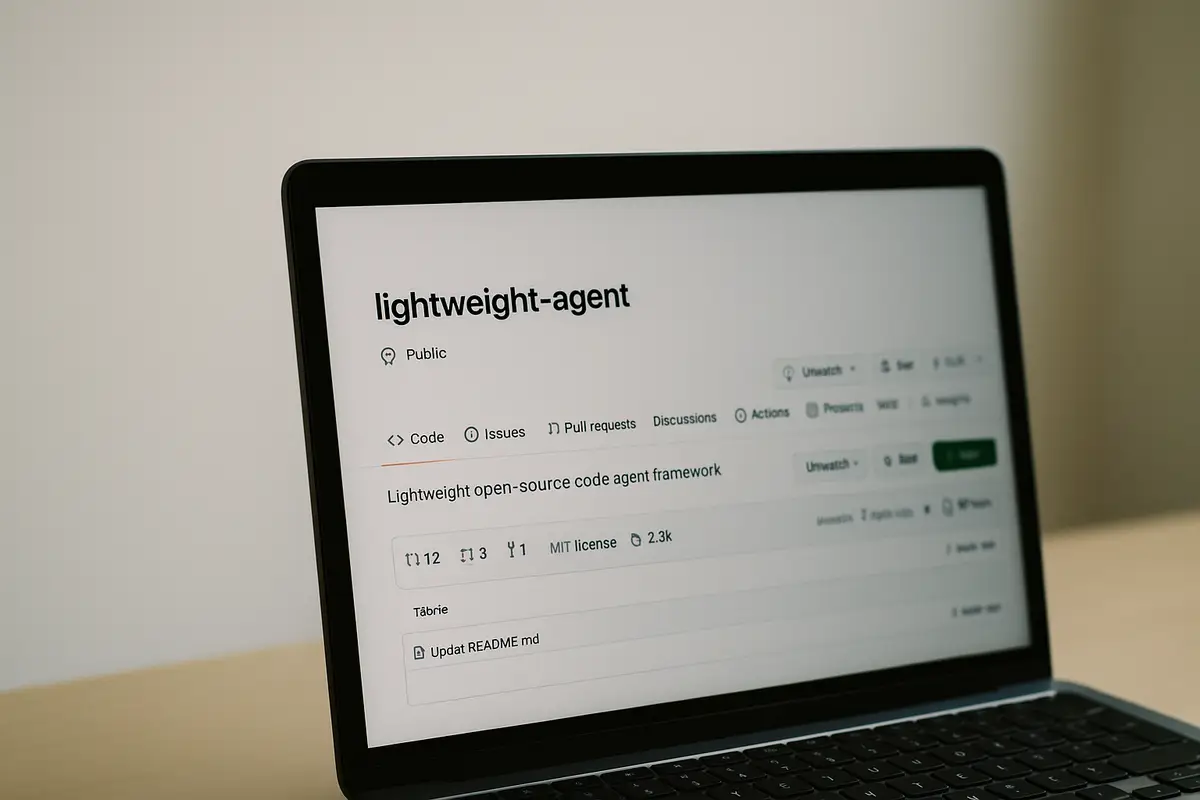
The open-source agent ecosystem experienced an explosive week in mid-September, with browser-use/jev-ultrafast accumulating nearly 19,000 GitHub stars in seven days—a velocity that reflects genuine developer demand for a specific problem: web automation without reliance on expensive or slow LLM APIs. The project, written in Python and positioned as the 'fastest and cheapest web agent,' gained 2,785 stars per day at launch, suggesting it solved a friction point that existing solutions (including Claude's native web interaction capabilities) had left unaddressed. Maintainers and early adopters point to three drivers: inference cost per task, latency constraints for real-time workflows, and the need for deterministic behavior in web scraping and form-filling scenarios where non-determinism introduces friction. Unlike Claude's integrated web browsing, which optimizes for general-purpose reasoning, browser-use targets developers building repetitive automation tasks where every millisecond and API call compounds across thousands of runs.
Parallel launches underscore a broader architectural shift within the agent development community. ZCode, Z.ai's coding agent harness (6,506 stars in three days), and laya-mlx, a native MLX runtime enabling 7–14ms inference decisions on Apple Silicon without PyTorch or cloud APIs, share a common theme: pushing decision-making to the edge. Laya-mlx explicitly targets offline scenarios—a developer building a web scraper can now embed local decision models that classify page elements or route logic without network latency. This contrasts sharply with the 2023 narrative of 'bigger models, more API calls.' Meanwhile, jev-chat-jarvis, a Kotlin-based mobile chat assistant that reads screens without hooking or modifying binaries, represents agent distribution beyond desktop and cloud contexts, reaching end-users directly through accessibility patterns. These projects collectively suggest that agents are fragmenting into specialized tools rather than converging toward monolithic LLM-powered systems.
The timing matters. Inference pricing and availability have become competitive differentiators as scaling pushes marginal costs higher; companies running millions of automated tasks monthly face genuine ROI pressure. Simultaneously, regulation around data handling and API dependencies is nudging enterprises toward on-device processing. The skepticism in the HN discussion about 'AI experts' who don't understand model mechanics points to a deeper developer sentiment: the industry overstated LLMs' universality. What's shipping now reflects reality—specialized agents for web browsing, coding, mobile interaction, and local inference. None of these projects claim to be pursuing AGI or general reasoning; instead, they optimize for the 80/20 case in their domain. This segmentation, evidenced by maintainers choosing TypeScript for harnesses, Python for inference runtimes, and Kotlin for mobile integration, suggests the agent ecosystem is maturing toward practical, componentized systems rather than awaiting the next breakthrough in LLM scale.