
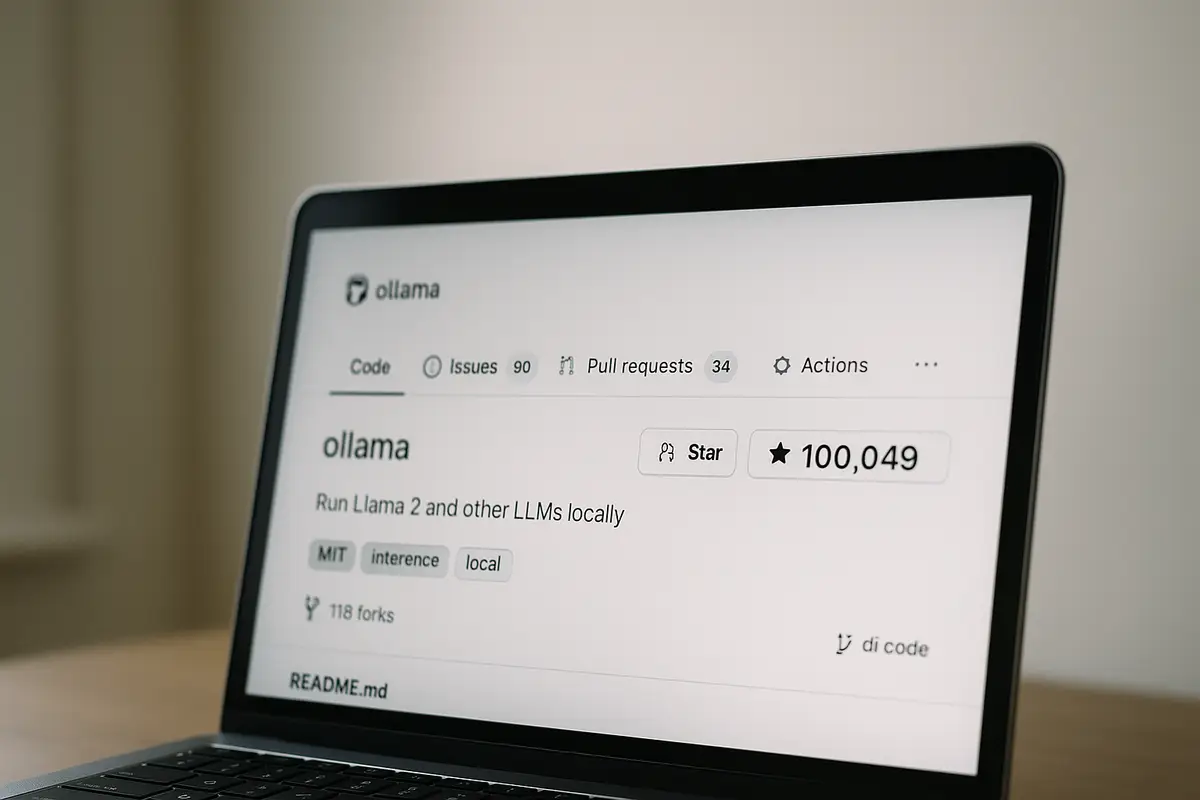
Ollama, the open-source tool for running large language models locally, crossed 100,000 GitHub stars in late 2024, marking a watershed moment in the developer community's relationship with AI infrastructure. The project, which simplifies downloading and running quantized models on consumer hardware, has gained roughly 30,000 stars in the past six months alone—a velocity that places it among the fastest-growing repositories in the machine learning category. This milestone arrived as developers grapple with OpenAI API costs that can reach $15-20 per million tokens for GPT-4 Turbo, versus near-zero marginal costs for locally hosted quantized models like Mistral 7B or Llama 2. The momentum reflects concrete economic pressure: a mid-sized SaaS startup processing 10 billion tokens monthly faces an API bill exceeding $100,000, while the same inference running locally on a $2,000 server cluster costs roughly $500 in electricity and hardware amortization.
What distinguishes Ollama's surge from earlier open-source hype is adoption velocity among production systems. Companies including Zapier, Replit, and various enterprise teams have publicly discussed swapping API calls for local inference pipelines using Ollama as the orchestration layer. The tool handles the friction points that previously locked developers into cloud dependency: model quantization (reducing a 70B parameter model from 140GB to 26GB), format conversion across GGUF and other standards, and streamlined CLI interfaces that abstract GPU memory management. GitHub data shows the project attracts contributions from experienced systems engineers—commit history reveals sophisticated work on CUDA optimization, ROCm support for AMD hardware, and multi-GPU parallelization. This technical rigor, combined with integration plugins for LangChain and Python libraries, has transformed Ollama from a novelty into genuine infrastructure.
However, the local inference wave encounters hard constraints that explain why major cloud providers haven't retreated. Quantized models consistently trade 10-15 percent accuracy loss versus full-precision originals—acceptable for summarization or chat, risky for financial analysis or legal compliance work. Inference latency for complex reasoning tasks remains 3-5x slower on consumer GPUs than optimized cloud TPUs. Perhaps most critically, maintaining local infrastructure requires ops overhead that startups lack: security patching, model updates, GPU driver stability. The real pattern emerging isn't API extinction but segmentation—local inference for high-volume, latency-tolerant workloads; APIs for accuracy-critical or bursty traffic. Ollama's 100K stars signals developers now have genuine choice, reshaping how teams architect AI systems around economics rather than defaulting to cloud convenience.