
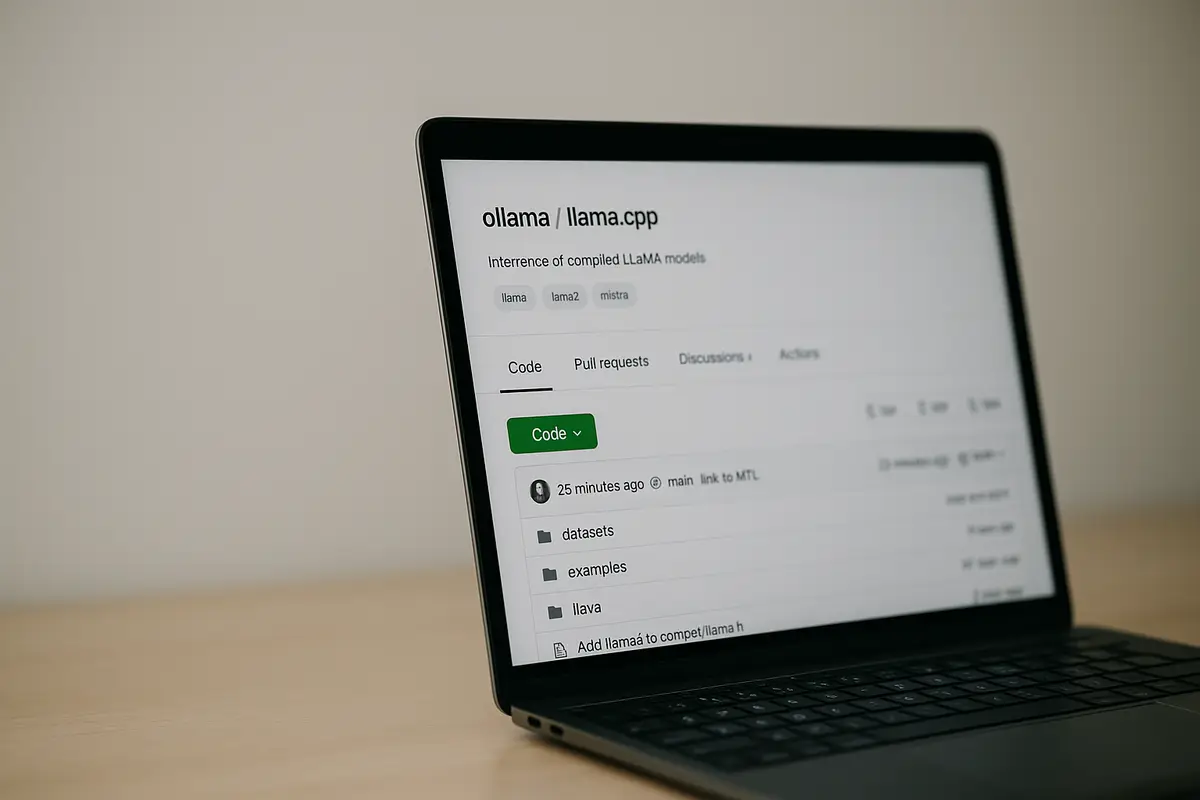
The GitHub trending landscape has undergone a seismic shift over the past six months, with local large language model tools now consistently outpacing traditional framework repositories in stars gained. Ollama, which packages open-source models like Llama 2 into a single executable, crossed 50,000 stars this year and regularly appears in trending lists. llama.cpp, a CPU-optimized inference engine that runs quantized models on consumer hardware, has gained similar momentum. Alongside these sits a constellation of quantization frameworks—GPTQ, AWQ, and similar projects—all designed to compress models so they run efficiently without GPU farms. The pattern is unmistakable: developers are no longer content relying solely on OpenAI's API or Anthropic's Claude service. They want models running locally, on their machines, under their control. This trend signals frustration with cloud API pricing models, latency concerns for latency-sensitive applications, and growing demand for privacy-preserving inference.
The practical drivers behind this shift are concrete and financial. Developers building chatbots, retrieval-augmented generation pipelines, or AI-powered search tools face cumulative API costs that escalate with usage volume. A developer running 100,000 inference requests monthly through OpenAI's GPT-3.5 Turbo faces charges that add up quickly; running the same workload through a quantized 7-billion-parameter model locally costs only electricity and compute time. GitHub contribution velocity metrics show quantization and inference projects attracting developers across industries—startups avoiding API bills entirely, enterprises seeking data residency compliance, and individual builders experimenting without subscription friction. The availability of high-quality open models like Meta's Llama 2, Mistral, and Qwen has made this transition viable. Where two years ago, locally-run models lagged significantly behind cloud APIs in quality, today's open alternatives achieve 80-90% parity on common tasks at a fraction of the cost.
Cloud providers and API vendors are already responding. Anthropic introduced lower-cost Claude models; OpenAI expanded its GPT-4 Turbo pricing tiers. AWS, Google Cloud, and Azure are investing in managed inference services for open models, effectively acknowledging they must compete on accessibility and cost, not model exclusivity. Yet the GitHub metrics tell a different story: developers are not waiting for cloud providers to optimize. They are building locally-first tooling, treating cloud APIs as premium-tier options for specialized use cases rather than defaults. This represents a fundamental recalibration of the AI development stack—one where infrastructure control and cost transparency matter more than outsourcing inference entirely. The trending repos are not abstract signals; they are evidence of production-grade adoption by developers solving real problems with finite budgets.