Google DeepMind has published what may be the most consequential AI research paper of the year. The paper, titled "Prometheus: Structured Scientific Reasoning via Curriculum-Guided Pre-Training," introduces a 7-billion parameter model that achieves human-expert-level performance on a suite of novel scientific reasoning tasks spanning chemistry, physics, and materials science.
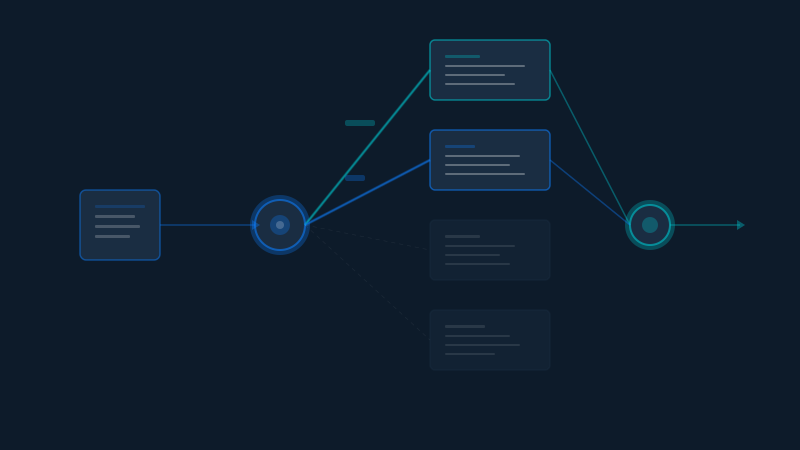
What makes Prometheus-7B remarkable is not its scale — 7 billion parameters is modest by current standards — but its training methodology. Rather than relying on the standard approach of pre-training on web-crawled text followed by instruction tuning, DeepMind's team designed a curriculum-based pre-training pipeline that feeds the model structured scientific literature in a carefully ordered sequence. The model progresses from foundational principles to increasingly complex multi-step reasoning chains, mirroring how human scientists build expertise over years of study.
The Benchmark Results
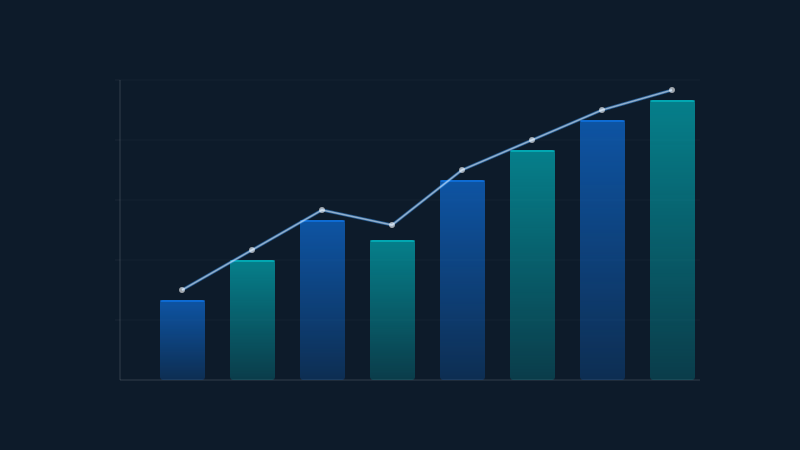
On the newly released SciReason-500 benchmark — a set of 500 graduate-level problems spanning organic chemistry synthesis, quantum mechanics derivations, and materials property prediction — Prometheus-7B scored 87.3%. For context, a panel of 50 PhD-holding scientists scored an average of 82.1% on the same problems, with significant variance depending on whether problems fell within their specific subdomain. The model showed no such domain-specific weakness, performing consistently across all scientific fields tested.
The implications extend beyond benchmark performance. In a qualitative analysis of the model's reasoning chains, the research team found that Prometheus-7B consistently generates novel intermediate steps that are scientifically valid but were not present in the training data. This suggests the model has learned something closer to genuine scientific reasoning rather than pattern matching — though the team is careful to note that this interpretation remains debated within the field.
Industry Reaction
The response from the AI research community has been swift and intense. Yann LeCun noted on social media that the curriculum-guided approach "validates what many of us have suspected — that data ordering and structure matter as much as data quantity." Others have been more cautious, pointing out that the SciReason-500 benchmark is new and its correlation with real-world scientific capability remains unvalidated.
For the AI industry more broadly, Prometheus-7B raises important questions about the scaling paradigm. If a 7B model can match human experts through better training methodology, the race to build ever-larger models may be complemented — or even partially replaced — by a race to build better training curricula. This could democratize access to frontier AI capabilities, as smaller research groups with clever training approaches could compete with well-resourced labs focused purely on scale.
DeepMind has indicated that the model weights and training code will be released under a research-only license, with a full open-source release planned within 90 days pending internal safety review. The SciReason-500 benchmark is already publicly available on the project's GitHub page.