
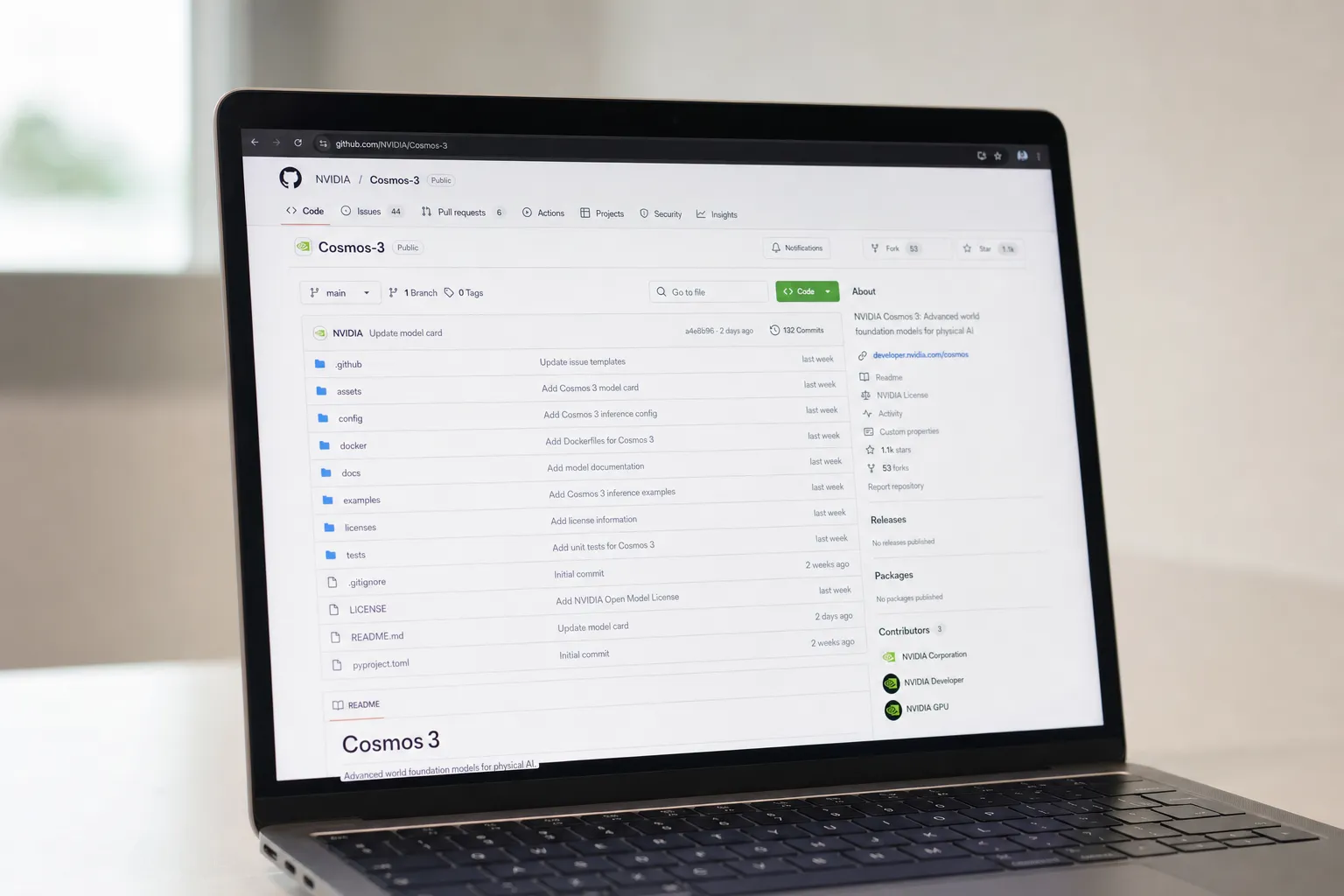
NVIDIA has released Cosmos 3, an open-source suite of world models designed to generate and predict video sequences, simulate interactive environments, and model complex physical dynamics. World models are neural networks that learn to predict how scenes evolve over time—they observe video data and anticipate future frames and object interactions. By releasing these models as open-source rather than proprietary APIs, NVIDIA significantly expands the open ecosystem for generative AI beyond language and image models. Cosmos 3 includes multiple model variants optimized for different compute budgets, making them accessible to researchers and developers from solo creators to large organizations. The models are trained on diverse video datasets including synthetic robotics simulations, gaming environments, and real-world footage. This release addresses a critical gap in open-source infrastructure: while language models like Llama and vision models have matured, open-source world models have been largely academic or behind paywalls.
Cosmos 3 models deliver measurable improvements over prior open-source baselines in video prediction accuracy and temporal consistency. The architecture supports inference on consumer GPUs without requiring specialized hardware, enabling local deployment and fine-tuning on custom data. For robotics, Cosmos 3 enables a concrete workflow: teams can simulate thousands of potential robot actions locally to find promising policies before testing on physical hardware. This in-the-loop simulation dramatically reduces expensive real-world trials needed to validate control algorithms. Game developers can use Cosmos 3 for procedural content generation—seeding simulations with scene descriptions and letting the model generate plausible environmental evolution. Autonomous vehicle research benefits from local, privacy-preserving simulation of traffic scenarios without reliance on cloud services or proprietary simulators. The ability to fine-tune models on domain-specific video data—recorded robot movements, game engine outputs, or traffic camera footage—means developers aren't constrained to general-purpose capabilities.
Cosmos 3 transforms the economics and accessibility of world modeling for builders. Previously, teams either built custom simulators in physics engines, conducted expensive real-world experiments, or relied on proprietary cloud APIs with latency and cost concerns. Now developers can download Cosmos 3, run it locally, fine-tune it on their data, and deploy without vendor lock-in or recurring service costs. This establishes world models as genuine infrastructure, similar to how Ollama made language models self-hostable. The open models enable reproducible research—results aren't dependent on closed API implementations that change. For robotics and simulation communities, local world models become standard tooling in development pipelines. Cosmos 3 demonstrates that open-source generative infrastructure is expanding rapidly: after language and vision, world models represent the next frontier for accessible, self-hosted AI. Developers now have complete tooling for creating autonomous systems, digital environments, and physics-informed applications without vendor dependence.