
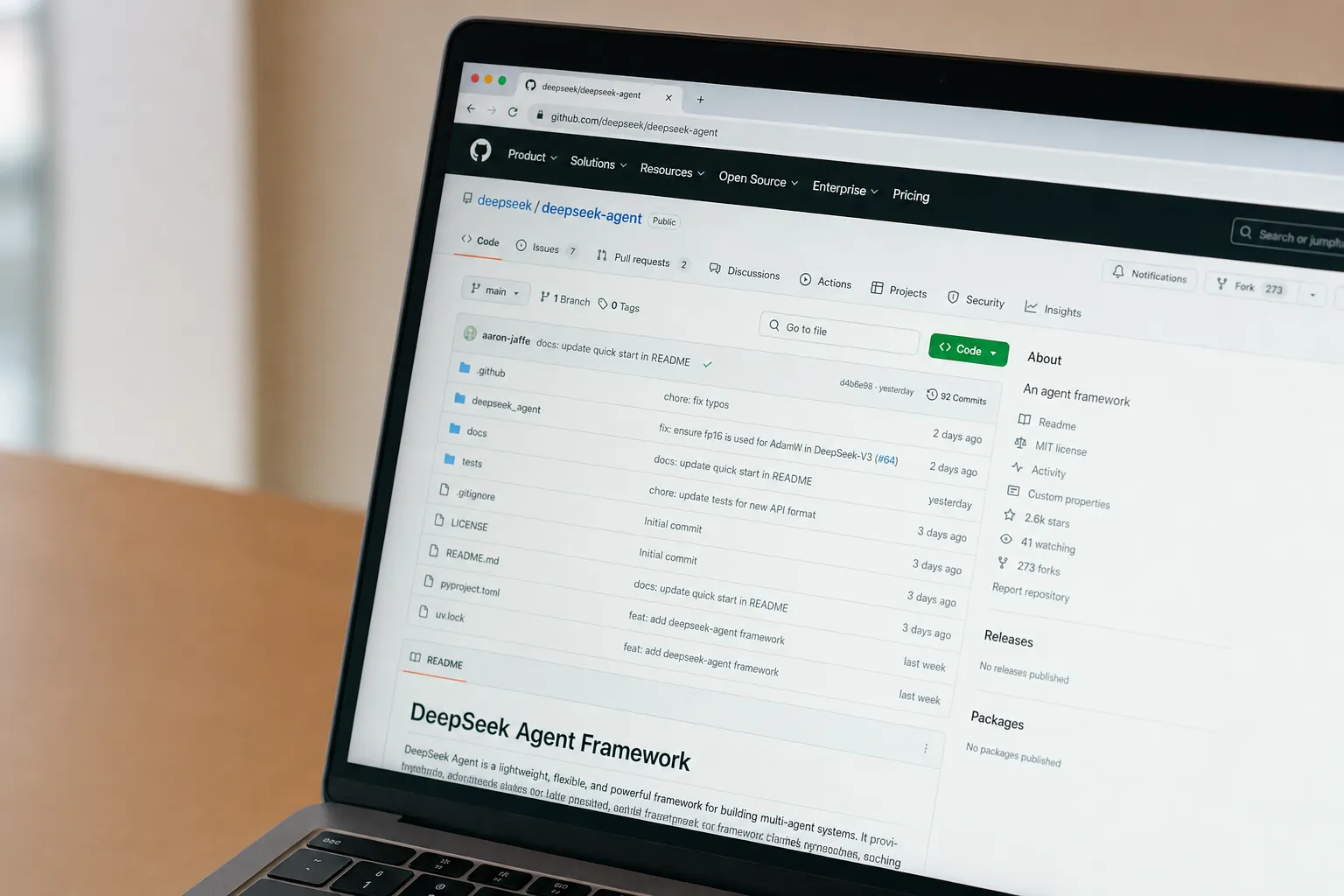
DeepSeek's newly released dsh-superagent-prototype has accumulated nearly 5,200 GitHub stars in just two days, signaling genuine developer interest in open-source alternatives to Anthropic's Claude agents and closed-platform solutions. Launched October 31, 2026, the MIT-licensed TypeScript framework explicitly positions itself as competitive with enterprise agentic AI, enabling developers to run autonomous reasoning and action loops locally without vendor lock-in. The timing matters: as enterprises increasingly demand cost control and data sovereignty, open-source agent tooling directly addresses the gap between expensive API-dependent systems and internal deployment. Bloomberg reported the release as a strategic move by DeepSeek to consolidate market share in autonomous reasoning, an area where open-source solutions have historically lagged proprietary offerings.
Technically, dsh-superagent-prototype enables agents to chain reasoning steps, execute functions, and iterate autonomously without human intervention at each step—a capability previously concentrated in closed systems. Unlike simple retrieval-augmented generation pipelines, the framework implements looping logic where agents formulate plans, execute API calls or code operations, observe outcomes, and adjust strategy iteratively. A concrete example: an agent could autonomously diagnose failing application behavior by analyzing logs, querying monitoring APIs, testing hypotheses, and generating remediation steps—tasks that previously required either expensive human expertise or cobbled-together prompt-chaining scripts. The architecture integrates with standard LLM providers while remaining flexible enough to run atop locally-hosted models via Ollama or llama.cpp, enabling fully air-gapped deployments. Early adopters report the system works but requires significant prompt engineering and careful task decomposition, not the 'plug-and-play' autonomy marketing suggests.
However, viral GitHub velocity masks a critical reality: stars accumulated in 48 hours do not equal production deployments. No major enterprises have publicly committed to dsh-superagent in shipping applications. The project lacks extensive documentation, battle-tested reliability patterns, and comparisons against Claude's agents in standard benchmarks. One developer in the HackerNews discussion noted instability with complex multi-step tasks and poor error recovery—issues that matter little for toy projects but catastrophically for business logic. Concurrent developments like Granite Switch 4.1.1's modular architecture and the proliferation of local model options (Mistral Large 4, open Nemotron releases) suggest the open-source agent ecosystem is diversifying rather than consolidating around any single framework. For practitioners, this moment presents genuine optionality: build on DeepSeek, abstract the layer with Granite's switchable models, or construct bespoke systems. Caution remains warranted until real-world case studies emerge.