
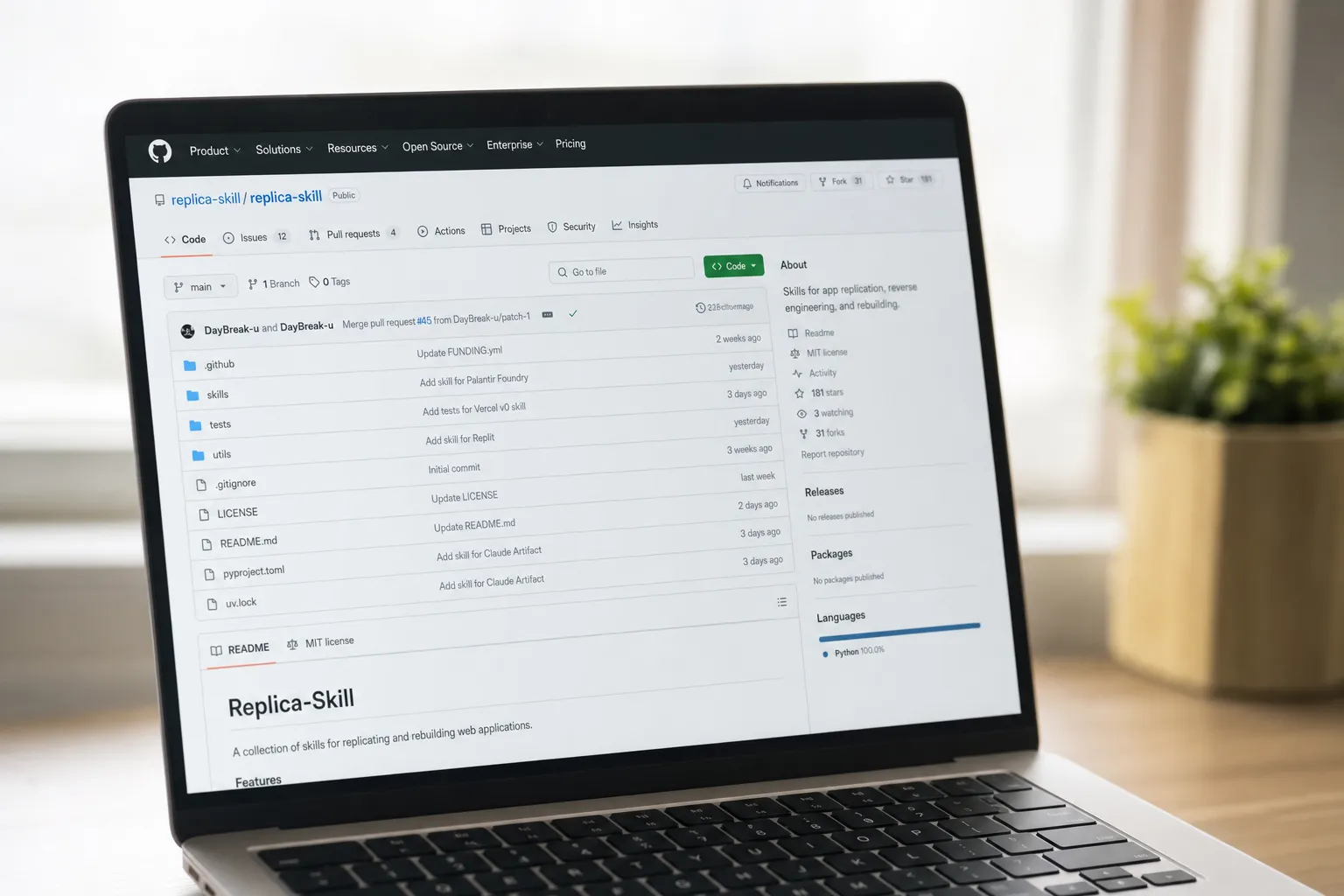
Replica-Skill, a freshly open-sourced toolkit that reached 6,142 GitHub stars within three weeks of launch, demonstrates a practical workflow for autonomous application analysis and reconstruction using Claude-based agents. The toolkit enables a concrete use case: feed it a live web application or mobile interface, and it orchestrates a multi-stage agent pipeline that first reverse-engineers the app's architecture, rebuilds a functional clone from scratch, executes test suites against the reconstruction, and finally diagnoses and repairs bugs discovered during testing. This isn't a single monolithic model but rather a composition of chainable Claude skills—discrete, reusable agent prompts and tools that can be sequenced flexibly. For example, a developer might invoke the reverse-engineering skill to generate architectural documentation, pipe that output into a rebuilding skill that generates code, then attach a testing skill that validates functionality, all without writing orchestration glue code. This composability addresses a fundamental limitation of existing agent frameworks like LangChain or LlamaIndex, which often treat agents as black boxes and force developers to rebuild task sequences for each new problem.
The MIT license and Python implementation mean the entire system can run on local infrastructure or self-hosted cloud instances, avoiding vendor dependencies on Claude's API beyond the underlying model inference itself. Competing approaches like CrewAI or Anthropic's native tool-use system require tighter coupling to specific LLM providers or impose heavier architectural assumptions. Replica-Skill's rapid adoption—246 stars per day since October 3rd—signals that developers are actively seeking modular, reproducible patterns for multi-step AI workflows. The project includes eleven pre-built skills covering the full app-cloning lifecycle, each independently tunable and extendable.
The toolkit's value lies in solving reproducibility and auditability challenges that plague current agent systems. When an AI system rebuilds an application or identifies a bug, users can inspect exactly which skills fired, in what order, and what context each step received—a significant advantage over opaque end-to-end prompting. For organizations deploying AI agents internally, this transparency becomes critical for debugging failures and validating safety properties. Replica-Skill positions itself at the intersection of open-source agent tooling and practical software engineering workflows, offering a concrete alternative to proprietary agent platforms and demonstrating how modular skill composition can be baked into the open ecosystem.