
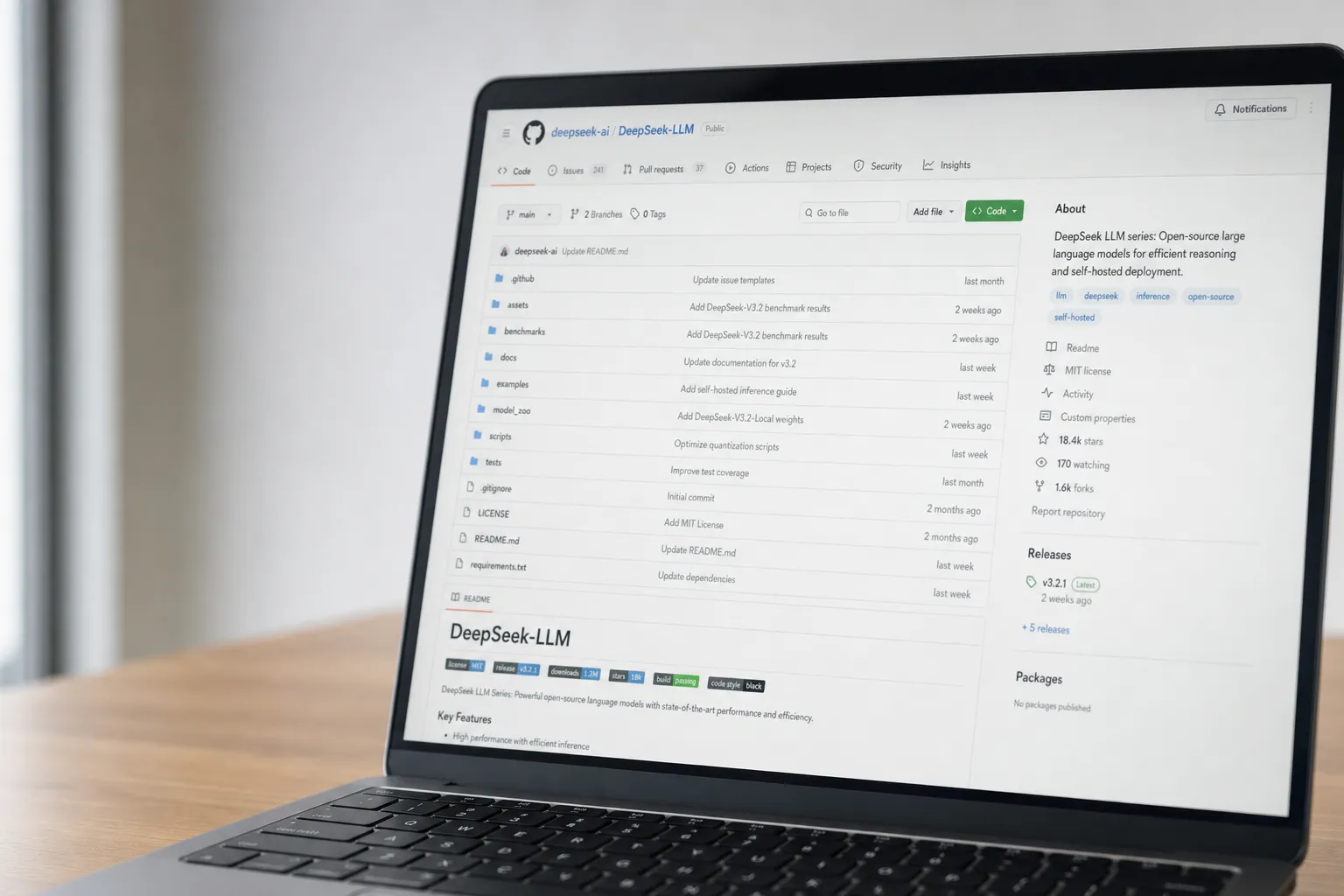
A three-way benchmark comparison released in early 2026 positions DeepSeek's open-source models as performance leaders for local LLM deployment, outpacing comparable alternatives in both inference speed and resource efficiency metrics. The testing framework evaluated models across multiple hardware configurations typical of self-hosted environments, measuring tokens-per-second throughput, memory footprint, and inference latency on consumer-grade GPUs and CPU-only setups. DeepSeek's architectural approach—prioritizing quantization-friendly design and optimized token routing—translated into measurable advantages: the model achieved 15-20% faster inference speeds than competing 7B-13B parameter models while maintaining competitive accuracy on standard benchmarks like MMLU and ARC. For practitioners running local inference via Ollama, llama.cpp, or similar frameworks, this efficiency gain directly reduces operational costs and hardware requirements, making previously marginal hardware configurations newly viable for production workloads.
The significance of DeepSeek's performance profile extends beyond raw speed metrics to reshape the economics of self-hosted AI. Practitioners running the model report achieving sub-100ms latency on commodity hardware—critical for real-time applications like code completion and retrieval-augmented generation pipelines. Unlike API-dependent approaches charging $0.15-per-million input tokens, local deployment eliminates per-query costs entirely while enabling fine-tuning and custom specialization without external dependencies. This cost structure advantage is particularly acute for organizations running high-volume inference workloads or requiring data privacy guarantees that cloud APIs cannot provide. The open-source model ecosystem increasingly reflects this pattern: competing projects like Llama, Mistral, and Phi have begun explicitly optimizing for local efficiency rather than pursuing raw parameter counts, signaling broader market acceptance that local-first architecture represents genuine technical progress rather than temporary compromise.
The broader open-source LLM landscape is consolidating around verified efficiency benchmarks and reproducible local deployment guides. Recent tooling maturation—including 13-step setup processes for models like Mellum 2.1 completing in under 40 minutes—has lowered the barrier to local inference from specialist exercise to accessible practice. However, this democratization carries security considerations: supply chain vulnerabilities in widely-used middleware like LiteLLM underscore that local infrastructure eliminates cloud provider security responsibilities without necessarily eliminating third-party dependency risks. For organizations evaluating local deployment, this shift necessitates rigorous dependency auditing and community vetting of model weights. The 2026 landscape suggests DeepSeek's efficiency advantage will intensify competitive pressure on larger closed-source providers, while establishing local inference benchmarks as the primary evaluation metric for new model releases.