
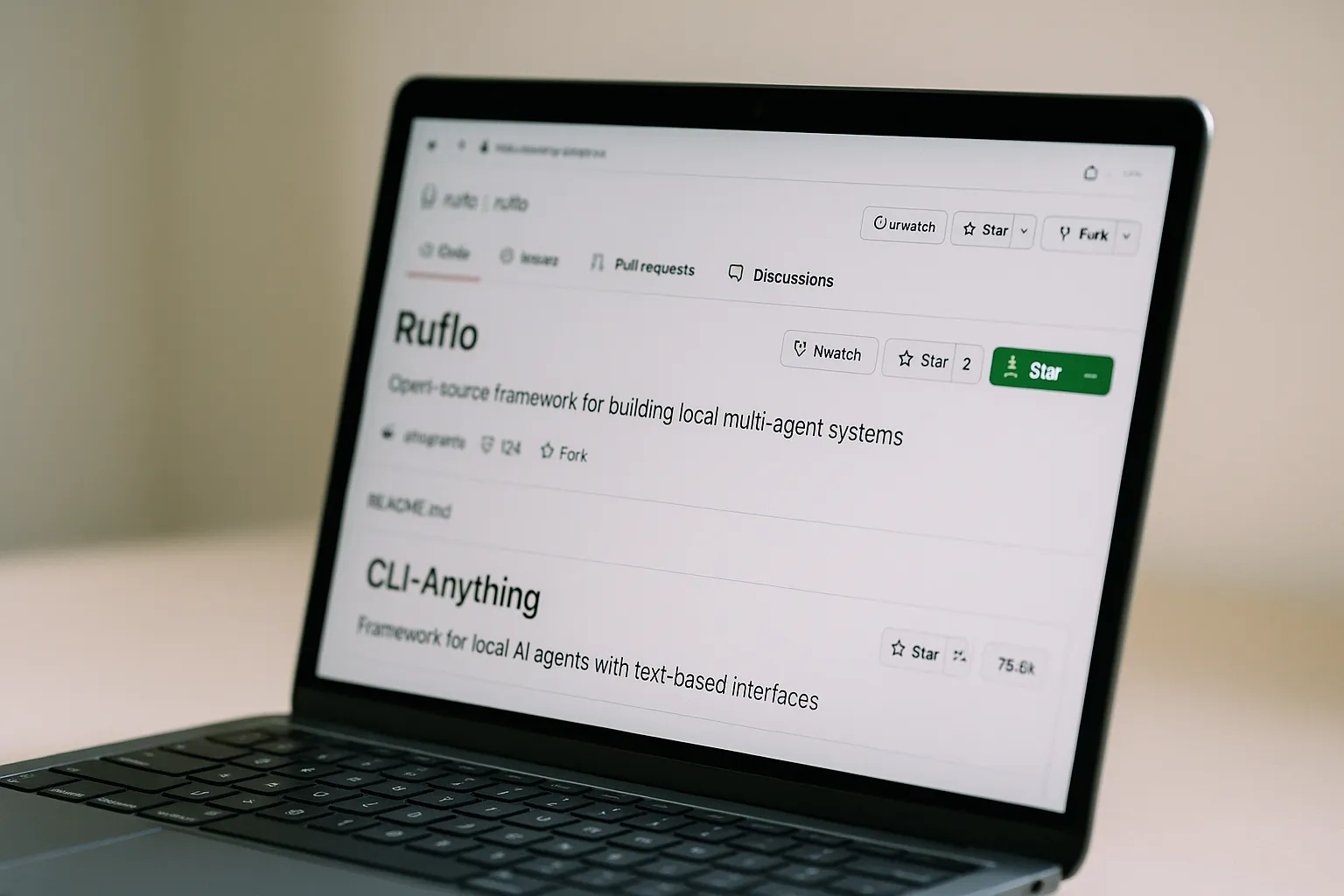
The open-source AI ecosystem has reached a pivotal inflection point. Two major agent orchestration frameworks—ruvnet/ruflo and HKUDS/CLI-Anything—have achieved extraordinary adoption velocity, accumulating 75,789 and 53,734 GitHub stars respectively, with each gaining hundreds of new stars daily. This isn't merely trend noise. These frameworks represent the first generation of production-ready, self-hosted alternatives to proprietary agent platforms and cloud-dependent API chains. Ruflo, written in TypeScript and released under MIT license, explicitly positions itself as an "original agent harness" capable of deploying multi-player agent swarms with native support for Claude, Codex, and Hermes models. CLI-Anything approaches the problem orthogonally, making existing command-line tools "agent-native" through a Python-based abstraction layer. Together, they signal a fundamental market shift: developers are prioritizing local deployment, federation, and independence from vendor ecosystems over convenience.
The practical appeal is straightforward. Building a multi-agent workflow under the old paradigm required orchestrating multiple API calls across services like OpenAI, Anthropic, and specialized tooling platforms like LangChain or Crew.ai—each call adding latency, cost, and dependency surface. With Ruflo, developers can define adaptive memory systems and self-learning intelligence locally, then coordinate autonomous workflows across distributed nodes without touching an external API. Consider a document processing pipeline: previously, you'd chain API calls for summarization, extraction, and classification, incurring $10-50 per thousand documents while waiting for round-trip network latency. With Ruflo's vector RAG integration and local model support, the same pipeline runs on-premise with near-zero marginal cost per document and sub-100ms latency. The economics fundamentally favor self-hosted approaches. Privacy becomes native—no data leaves your infrastructure. Iteration speed accelerates; you deploy changes instantly rather than waiting for provider rate limit resets. For teams handling sensitive data, regulated content, or running at scale, local deployment isn't optional.
This shift directly cannibalizes existing vendor relationships. LangChain and Crew.ai, while powerful, remain cloud-first abstractions that facilitate integration with remote APIs. Proprietary platforms like Anthropic's Workbench or OpenAI's API-only agent frameworks offer convenience but guarantee perpetual dependency. Ruflo and CLI-Anything aren't marginal improvements—they're architectural alternatives. The open-source advantage compounds as more developers contribute integrations for local models (Llama, Mistral, Phi via Ollama and llama.cpp), RAG backends, and specialized agents. Parallel developments like 4Paradigm's ModelSphere further normalize heterogeneous LLM serving, enabling single systems to route tasks across multiple model types without vendor affinity. The industry consequence is stark: the winners will be frameworks and model providers that embrace decentralization, not platforms betting on API dependency. For teams building production AI systems in 2025, self-hosting is no longer a cost-cutting exercise—it's the default assumption. The 75K+ developers rallying around these projects aren't early adopters chasing novelty; they're pragmatists recognizing that local, distributed, open-source workflows have become materially superior to cloud-API alternatives for most real-world use cases.