
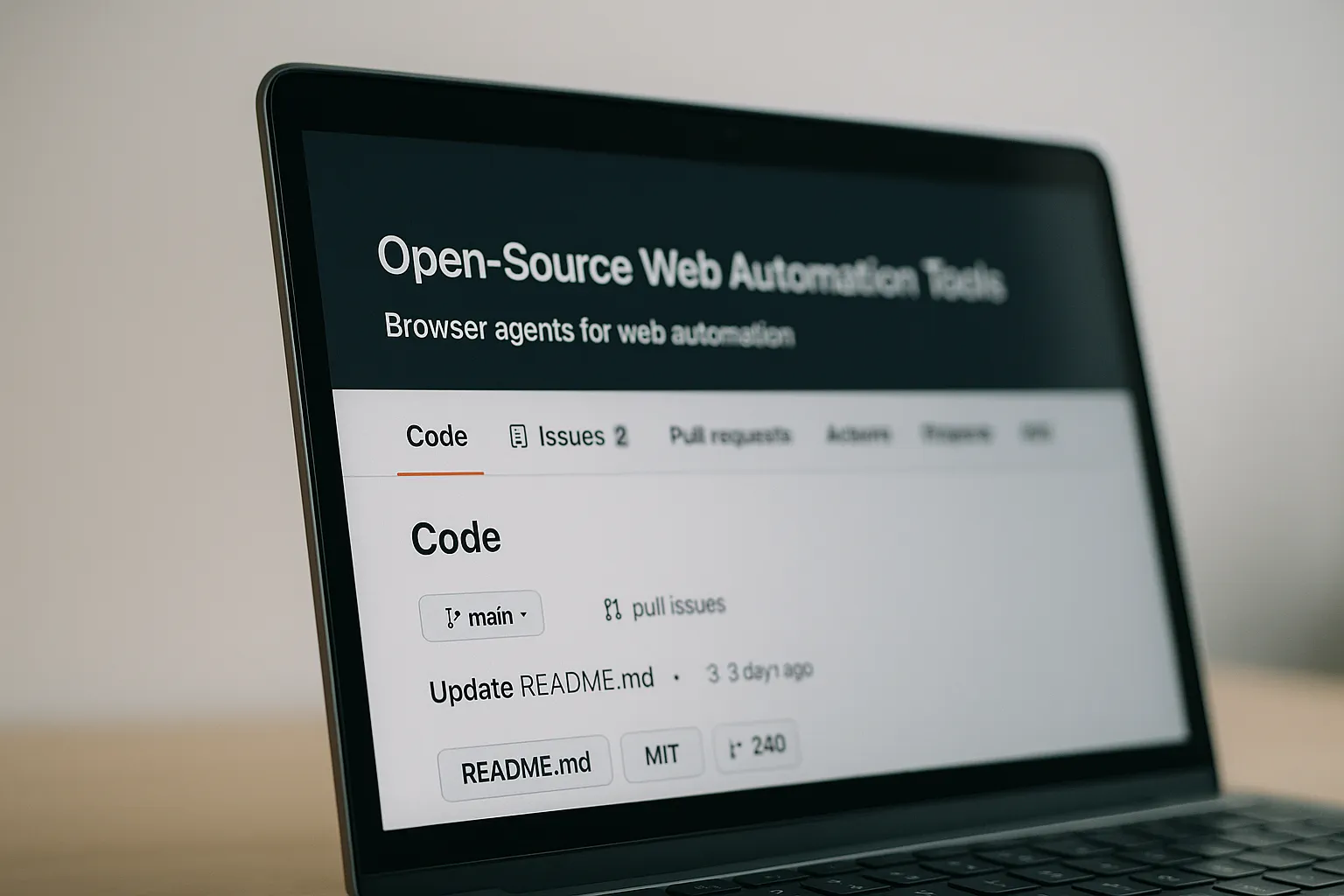
The web automation agent space is consolidating around a performance-first philosophy. Scout, which launched just two days ago on GitHub, accumulated 790 stars and climbed 381 stars per day—a trajectory that rivals month-old projects. Built in TypeScript and Apache-licensed, Scout emphasizes browser agent flexibility through CDP (Chrome DevTools Protocol) bindings. Concurrently, jev-ultrafast has accumulated 22,967 stars in just 29 days by explicitly positioning itself as the 'fastest and cheapest web agent' available. The framing matters: neither project leads with conversational AI or natural-language planning. Instead, both target developers who need reliable, cost-effective browser automation at scale. This represents a departure from earlier agent frameworks that wrapped everything in LLM orchestration layers, treating the language model as the central abstraction.
The competitive tension between these approaches reveals a real production friction point. jev-ultrafast optimizes for throughput and per-request cost, critical for high-volume tasks like data scraping, form-filling, or competitive monitoring. Scout trades some speed for architectural flexibility—allowing developers to compose browser actions programmatically without LLM latency overhead. TeamOut's retreat-planning agent, shipped by YC W22, demonstrates how this infrastructure matters in practice: planning a company event requires orchestrating vendor APIs, calendar constraints, and budget decisions. An event-planning agent that waits for LLM tokens on every vendor lookup becomes unresponsive. Instead, production agents need fast, deterministic decision pathways punctuated by LLM reasoning only when truly needed—a pattern jev-ultrafast and Scout both enable. Meanwhile, ECC's 279,826-star repository indicates strong demand for Claude-integrated agentic coding, showing that developer-tool agents (powered by LLMs like Claude) remain high-velocity, while web-automation agents increasingly decouple from pure LLM dependency.
What's emerging is a bifurcated agent landscape. Conversational agents—like TeamOut's retreat planner—remain LLM-heavy because their primary value is understanding ambiguous human intent. Web agents, by contrast, increasingly look like traditional automation tools that happen to be scriptable or AI-enhanced, rather than AI-first products. The risk: fragmentation. If Scout, jev-ultrafast, and other emerging projects don't establish shared standards for task specification and observability, developers will face another round of 'which framework for which problem' decision paralysis. The opportunity: consolidation around a minimal, open spec for browser-agent behavior could unlock an ecosystem as productive as Puppeteer or Selenium was for QA, but with AI-native planning. The next signal to watch is whether these projects converge on interoperable agent protocols or fork into incompatible tool-specific variants.