
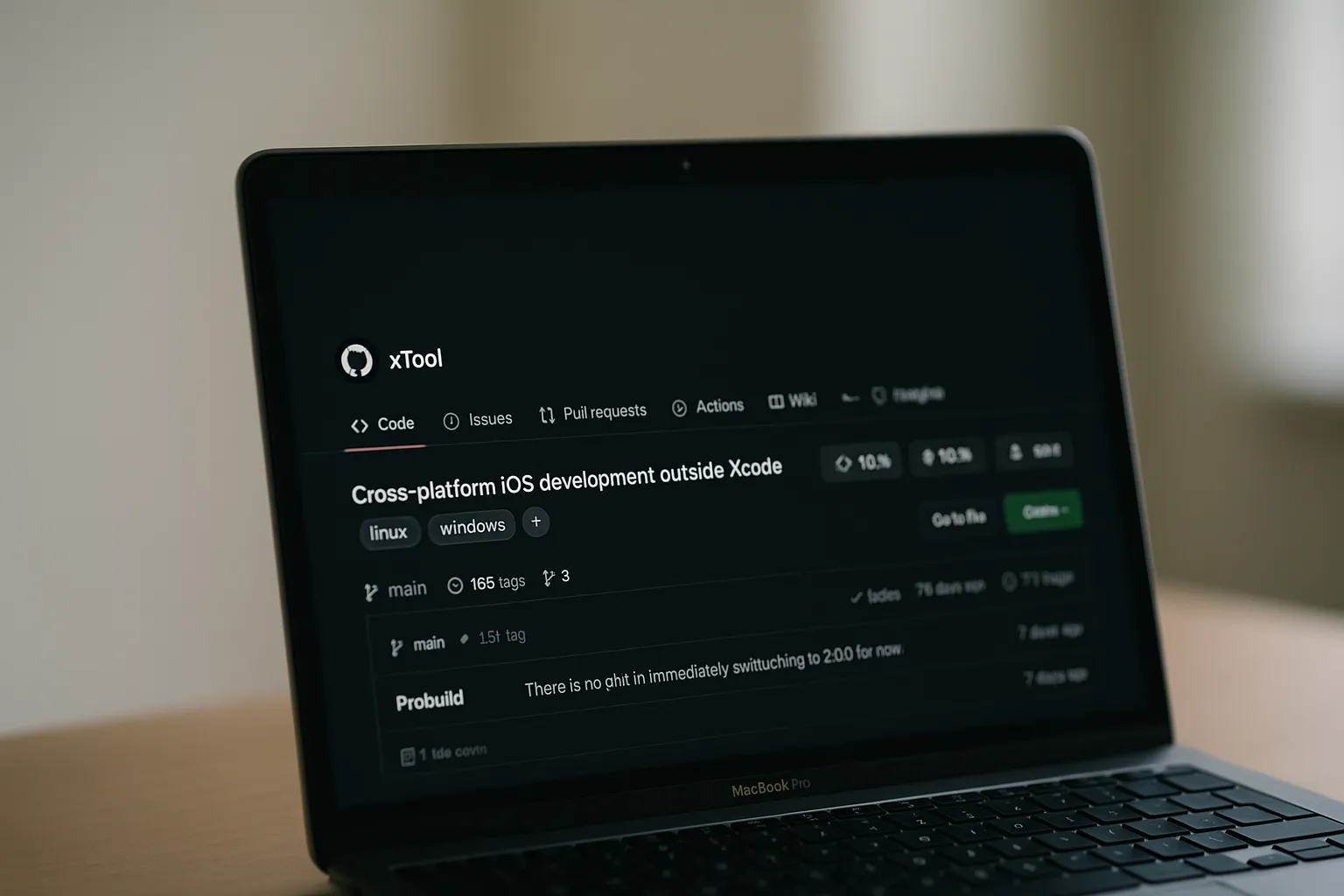
XTool crossed 9,770 stars on GitHub today, with 1,198 new stars added in the past 24 hours alone. The MIT-licensed project, created in November 2024 and now 696 days old, positions itself as a genuine cross-platform Xcode replacement rather than a wrapper or emulator. Written entirely in Swift, XTool enables developers to compile, build, and deploy iOS applications using SwiftPM (Swift Package Manager) natively on Linux, Windows, and macOS—eliminating the historical requirement of owning an Apple computer to ship to iOS. The repository has accumulated 412 forks, indicating strong community investment in maintaining and extending the toolchain.
The timing of today's surge appears tied to renewed attention within developer communities discussing platform lock-in and toolchain accessibility. XTool addresses a persistent pain point: while web and backend developers enjoy true cross-platform freedom, iOS developers have remained tethered to Xcode and macOS infrastructure costs. A Windows-based startup team, for example, can now onboard iOS development without purchasing M-series MacBooks or maintaining a hybrid build infrastructure. This eliminates hundreds of thousands in capital expenditure and operational complexity for organizations building multi-platform products. The project's momentum reflects broader frustration with platform-specific tooling in an era of containerization and cloud development.
Technically, XTool leverages SwiftPM's modular architecture to replicate Xcode's compilation pipeline without the IDE overhead. Developers can use familiar command-line workflows—running `swift build` on Linux to generate iOS binaries—while maintaining access to iOS frameworks and signing workflows previously locked within Xcode's graphical interface. The toolchain handles code signing, provisioning profiles, and simulator integration through declarative configurations rather than XML plists. Unlike community projects that simply port language features, XTool reconstructs the entire build and deployment chain, making it production-viable rather than experimental.
In context, 10K stars represents meaningful ecosystem adoption but not yet critical mass compared to established shifts. When Rust-based tooling like `esbuild` and `swc` disrupted JavaScript's build ecosystem circa 2020–2021, they accumulated similar star counts over 18–24 months before becoming industry standard. XTool's single-day surge suggests concentrated developer interest rather than viral adoption. To truly threaten Xcode's dominance, XTool must achieve parity on debugger experience, IDE integration (VS Code extensions, Neovim support), and institutional support from organizations building at scale. Apple, meanwhile, faces pressure not from XTool's technical superiority but from its existence: it signals that enforcing platform lock-in via tooling has become untenable in modern development culture. The company's response will likely involve opening SwiftPM further and improving macOS development costs rather than blocking competing implementations.
The surge underscores a developer community in transition: tooling independence and platform agility now rank alongside language features as procurement criteria. For iOS development, that shift has arrived.