
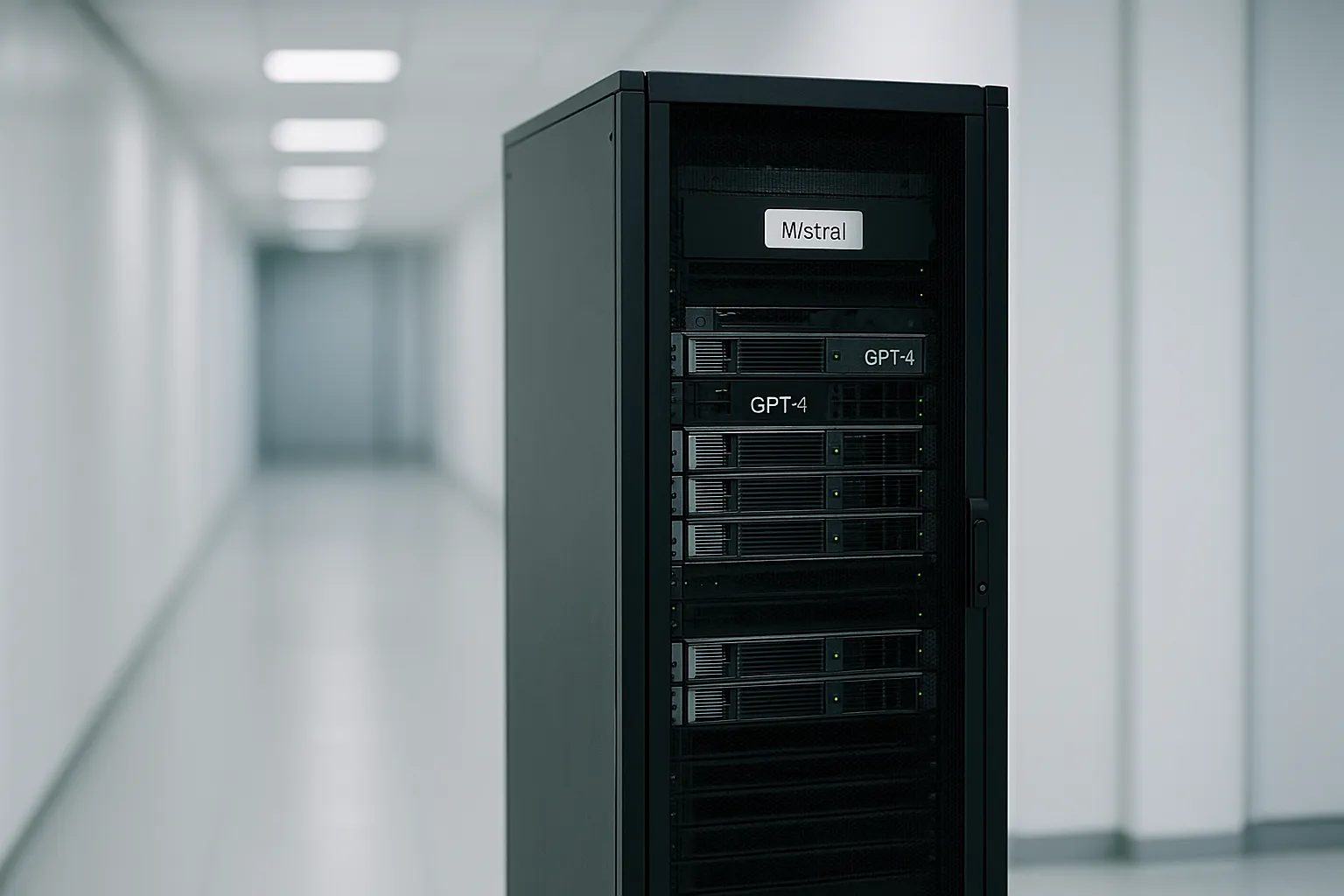
Mistral AI has released Mistral Large 4, an open-source large language model that benchmarks competitively with OpenAI's GPT-4 on complex reasoning tasks, marking a significant inflection point for the self-hosted and local LLM ecosystem. According to Mistral's published benchmarks, the model achieves parity or marginal improvements on MATH, coding evaluations, and multi-step reasoning tasks compared to GPT-4, while maintaining a substantially smaller parameter footprint that enables practical local deployment. This capability-to-size ratio matters enormously: organizations can now run models with GPT-4-level reasoning locally via Ollama or llama.cpp, rather than paying per-token fees to cloud API providers. The release comes with Mistral's updated AI roadmap, signaling sustained investment in the open competitive landscape and challenging the assumption that frontier reasoning capabilities require proprietary, closed platforms.
The practical implications for self-hosted deployments are substantial. A mid-sized enterprise processing sensitive financial or healthcare data can now run Mistral Large 4 on on-premises GPU infrastructure—using quantized 4-bit or 8-bit variants via llama.cpp to reduce memory footprint—and eliminate recurring API costs entirely. For instance, a company processing 10 million inference tokens monthly through OpenAI's GPT-4 API pays roughly $300; the same workload on self-hosted Mistral Large 4, amortized across modest GPU compute over 12 months, often costs 10–20% of that figure. Beyond economics, latency becomes predictable (no cloud round-trips), and data never leaves private infrastructure. This viability spans three critical dimensions: cost reduction via elimination of per-token pricing, latency predictability for real-time applications, and data sovereignty for compliance-heavy sectors.
The broader open-source ecosystem is accelerating in response. HuggingFace continues hosting quantized versions of Mistral's models, enabling one-click downloads for Ollama and llama.cpp users. Quantization research—particularly 4-bit and mixture-of-experts pruning—now approaches closure between quantized and full-precision performance, removing the traditional accuracy tax of local inference. For developers and organizations, the message is clear: frontier-class reasoning no longer requires dependency on proprietary APIs. Mistral Large 4 demonstrates that open-source models have crossed a threshold where local deployment is not a compromise but a strategic advantage.