
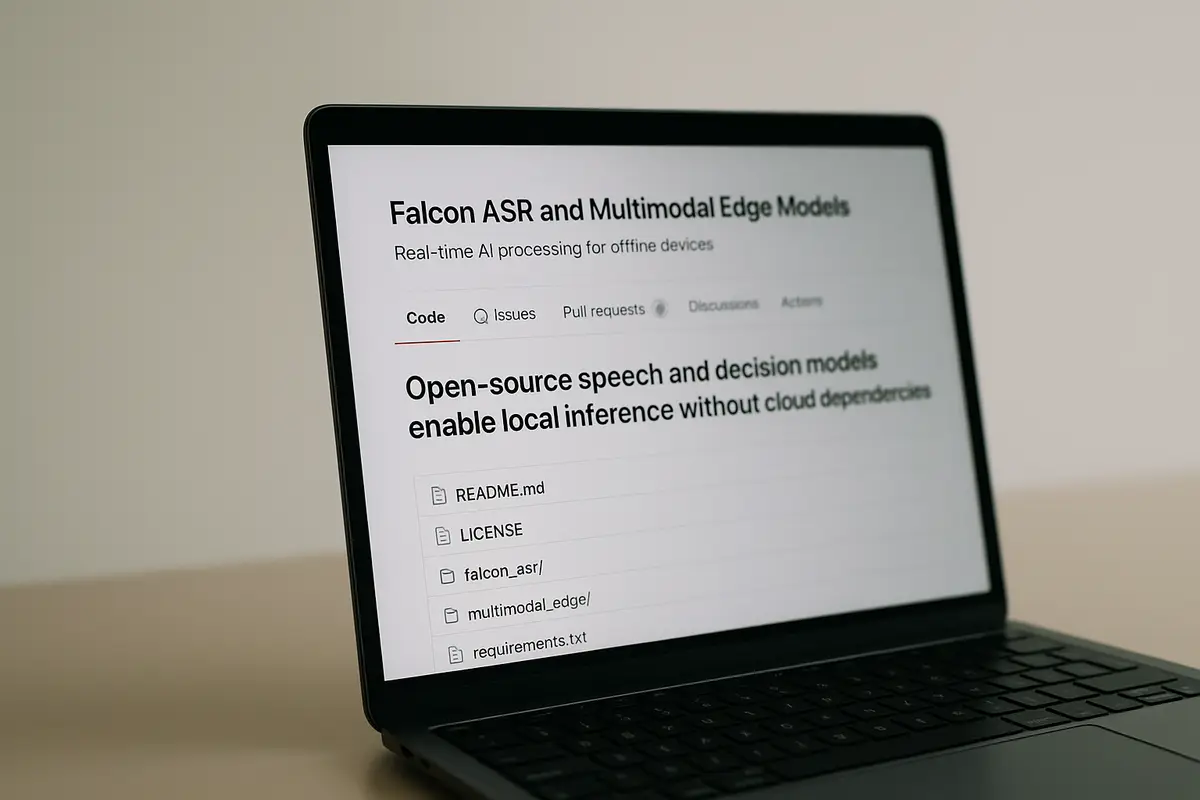
Falcon ASR represents a significant shift in speech recognition accessibility for self-hosted deployments. Unlike proprietary cloud-based speech-to-text systems that require persistent network connectivity and incur per-request API costs, Falcon ASR is designed to run entirely on local hardware—from edge servers to individual workstations. This eliminates round-trip latency inherent to cloud calls, typically reducing speech-to-text processing time from 500-2000ms network overhead to sub-100ms local inference on mid-range GPUs. For organizations processing high-volume audio streams, the cost differential is substantial: a company transcribing 100 hours of audio daily would pay approximately $1,200 monthly through commercial APIs, while local Falcon ASR deployment costs only initial hardware investment and negligible electricity overhead. The release comes as HuggingFace's Transformers framework continues its expansion—now at 167,104 GitHub stars with 94 new stars daily—indicating sustained developer momentum in the open-source AI ecosystem.
Complementing speech capabilities, emerging multimodal open decision models specifically optimize for edge deployment, addressing a distinct technical challenge: simultaneous processing of multiple input types (image, text, sensor data) with real-time decision output on resource-constrained hardware. A concrete use case is autonomous vehicle routing: a vehicle's edge compute module must simultaneously process camera feeds, GPS coordinates, and traffic data to decide route changes within milliseconds—delays measured in seconds create safety hazards. Traditional cloud-dependent systems introduce unacceptable latency. Edge multimodal decision models run this inference stack locally, keeping decision loops under 50ms, which is critical for safety-critical applications. Medical imaging represents another deployment scenario: hospitals can run diagnostic assistance models on radiology workstations without transmitting patient imaging data externally, satisfying HIPAA compliance requirements while enabling real-time clinician feedback.
The broader open-source ecosystem reflects this maturation. Eighteen months ago, local LLM infrastructure required substantial expertise—llama.cpp and Ollama were emerging, model quantization was poorly documented, and few models were optimized for sub-4GB inference. Today, production-grade tooling is standardized, model variety spans specialized domains (medical, legal, code, speech), and quantized variants enable inference on consumer laptops. Developer adoption metrics support this trend: HuggingFace's model hub now features thousands of task-specific models with explicit hardware requirement documentation. These releases demonstrate the open-source AI sector is transitioning from theoretical advantage to operational utility—enterprises can now self-host production workloads, reducing API dependency and achieving predictable, auditable inference pipelines.