
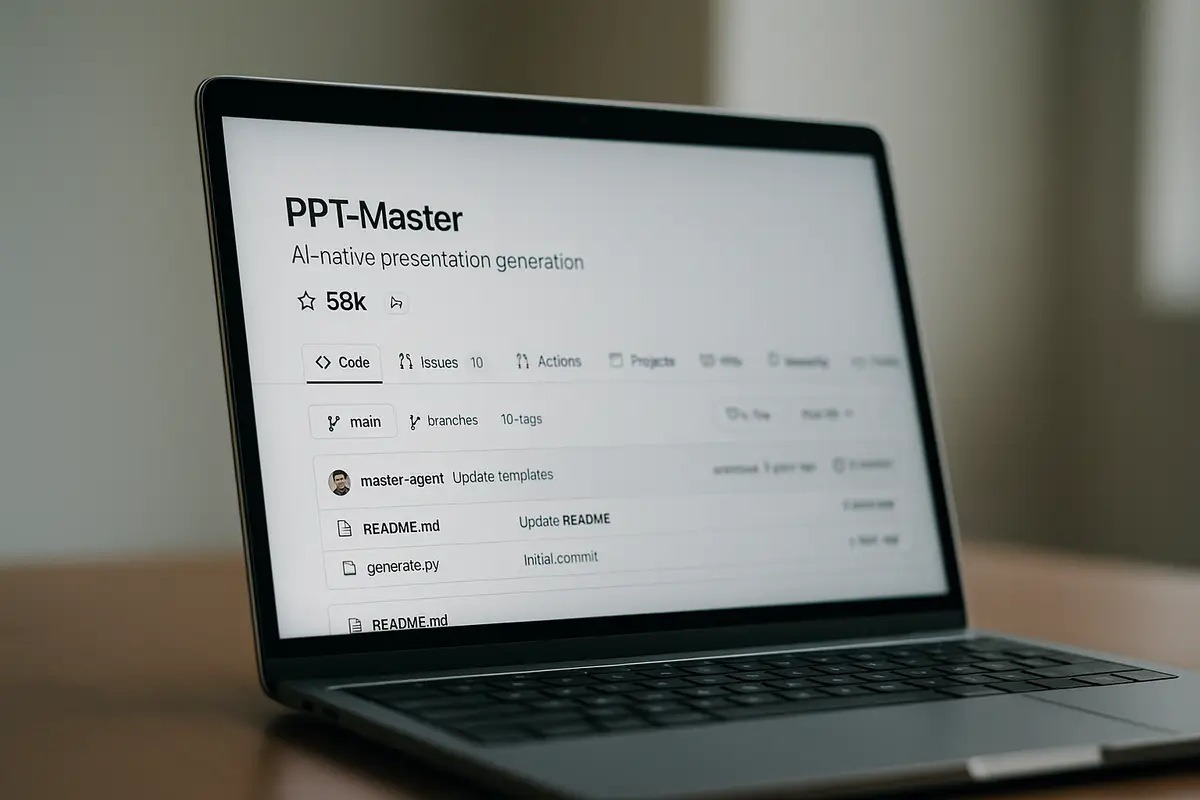
PPT-Master's surge to nearly 59,000 stars—gaining 372 in a single day—reflects a broader inflection in how developers are solving a stubborn enterprise problem: presentation automation that doesn't feel like automation. Traditional document-generation tools either produce bland, templated output or require brittle web scraping hacks against GUI-based tools. PPT-Master sidesteps that entirely by generating native .pptx files with real shapes, transitions, animations, and data-backed charts. The killer feature, though, is audio narration from speaker notes—meaning a single AI agent can now produce a complete, broadcast-ready deck without human touch-up. For sales automation platforms, investor pitch workflows, and compliance reporting systems, this eliminates an entire class of manual handoff labor that previously couldn't be reliably automated.
The architecture reveals why this tool is gaining traction among production builders. PPT-Master doesn't just convert text to slides; it orchestrates multiple design and media layers—parsing your input document or topic, reasoning about narrative flow, querying data sources for live-backed tables and charts, generating speaker notes, synthesizing audio, and applying your organization's .pptx template as an overlay constraint. That orchestration is the hard part. Consider a real estate firm automating property listing decks: agents upload photos and comps data, and PPT-Master needs to select relevant photos, generate market commentary, insert comparable sales as styled tables, add animations to highlight price deltas, and narrate talking points—all while respecting brand guidelines embedded in the template. This isn't templating; it's agentic reasoning applied to a constrained output format. The MIT license and Python foundation also mean teams can fork and customize the media pipeline, critical for enterprises that demand bespoke workflows. That combination—LLM-powered content reasoning plus template-aware output generation—is why the repository is resonating with builders shipping production AI.
PPT-Master's trajectory parallels a pattern we're seeing across trending repositories: tools that solve the 'last-mile' problem of AI outputs in enterprise systems. Meta's Astryx, which uses JSON manifests to prevent UI hallucination, and the widespread adoption of Andrej Karpathy's Claude.md prompt guidelines (217K stars) both reflect the same underlying insight—raw LLM output is fragile in production; you need guardrails, schemas, and domain-specific constraints to make AI agents reliable at complex tasks. PPT-Master adds a new dimension: multimedia orchestration. The business consequence is concrete: teams that previously needed dedicated roles for deck production, narration, and design coordination can now route that work through a single AI-powered pipeline. For consulting firms, corporate communications departments, and B2B SaaS sales teams, that's a 60-70% reduction in deck turnaround time and a meaningful shift in how AI labor redistributes within organizations. The spike in stars signals that developers have stopped asking 'can AI generate presentations?' and started asking 'how do I integrate presentation generation into my product stack?'—a shift from novelty to infrastructure.