
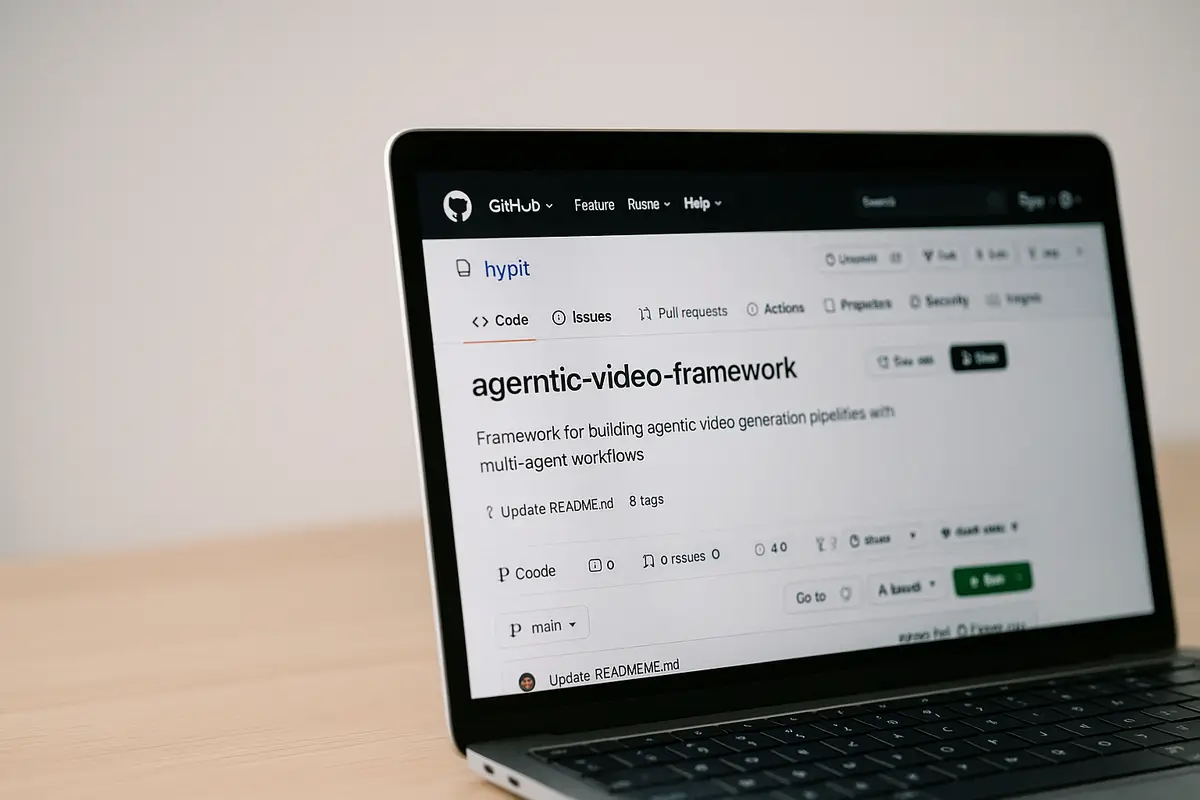
Hypit, an open-source agentic AI framework written in TypeScript, has accumulated over 20,500 stars in just 72 days, signaling strong developer interest in AI agents designed for real production workflows. The project enables users to clone viral videos at scale—swapping faces, regenerating dialogue, replacing B-roll footage, and shipping 100 video variants in a single command. Rather than positioning itself as a simple script or wrapper, Hypit frames itself as a complete workflow orchestration system, using a domain-specific language (DSL) and compiler to coordinate multiple AI agents across video processing, synthesis, and delivery tasks.
What distinguishes Hypit from typical LLM chatbot applications is its focus on orchestrating complex, multi-step autonomous processes. The framework compiles high-level commands into executable agent workflows that handle video manipulation, speech synthesis, and variant generation—tasks requiring coordination across specialized models and tools rather than pure language understanding. This represents a meaningful shift in how developers are shipping AI agents: moving away from single-turn interactions toward sophisticated pipelines where autonomous systems manage interdependent steps, handle failures, and produce tangible media outputs at scale.
The rapid adoption reflects growing developer demand for agentic frameworks that handle real-world complexity. Hypit's success indicates the market is maturing beyond proof-of-concept chatbots toward production-grade autonomous systems that manage concrete workflows. Similar momentum is visible in other recent projects like aurelio-finance and UpTrain, which apply agent-like reasoning to specialized domains like finance and LLM evaluation. For the AI agent sector, this signals that developers are ready to trust autonomous systems with increasingly sophisticated tasks—provided frameworks exist to reliably orchestrate, compose, and control them.