
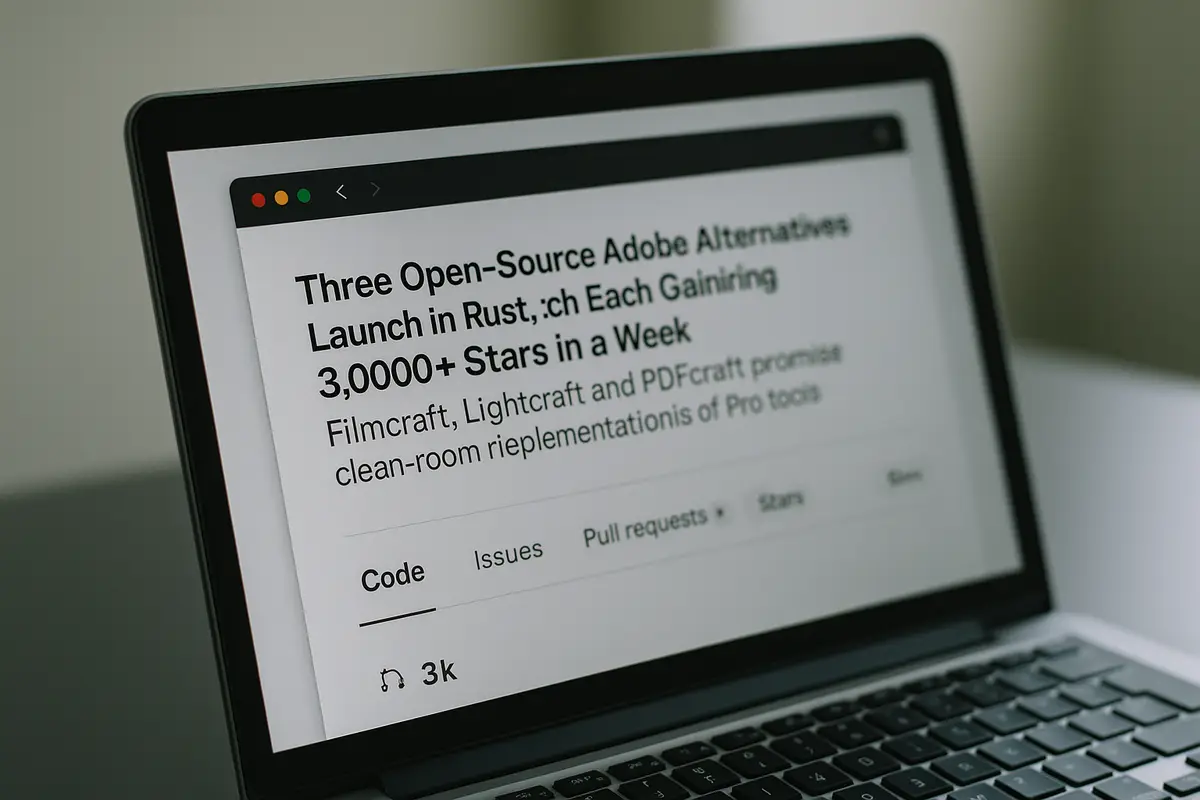
Three new repositories appeared on GitHub's trending list simultaneously on September 30, each claiming to be a clean-room reimplementation of a core Adobe product. Filmcraft (4,041 stars) targets Premiere Pro, Lightcraft (3,867 stars) reimplements Lightroom, and PDFcraft (3,219 stars) rebuilds Acrobat—all written in Rust under Apache 2.0 licenses. All three projects are credited to accounts under the 'storytold' organization, though public documentation does not explain the team's composition or coordination. Each project has accumulated roughly 400–500 stars per day since launch, suggesting sustained developer interest rather than a single viral spike.
The simultaneous release raises immediate questions about the scope of these implementations. None of the three projects has published detailed feature matrices or working demos that would clarify how close they track their Adobe counterparts. PDFcraft, the smallest by stars, operates on document parsing and manipulation—a narrower surface area than video export with 4K support or photo RAW processing. Filmcraft and Lightcraft target professionals who depend on specific workflows: color grading pipelines, timeline scrubbing performance, and compatibility with third-party plugins. The GitHub repositories do not yet address whether these implementations can handle the scale, speed, or integration points that Creative Cloud users rely on daily. Early adopters will need to test whether these tools function as genuine alternatives or educational proofs-of-concept.
The Rust foundation itself signals a technical bet on memory safety and single-binary deployment, reducing packaging friction compared to traditional electron or C++ builds. However, the developer community's immediate response reflects appetite for open-source media tools rather than validation of feature parity. The broader pattern—three substantial projects landing at once under unclear organizational ownership—merits monitoring. If maintainers provide concrete roadmaps addressing professional workflows, these could represent meaningful competition for Adobe. Without clarity on governance, funding, or planned feature support, they currently function as compelling starting points rather than drop-in replacements.