
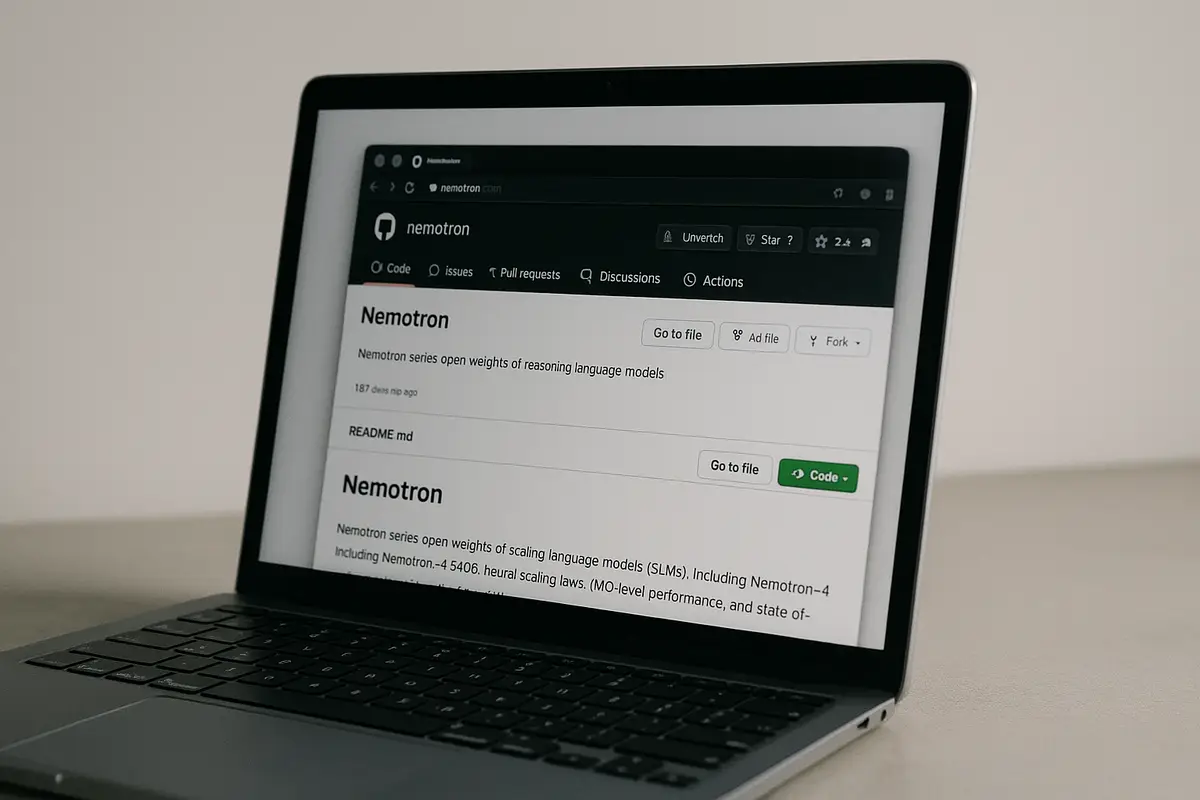
Nvidia has open-sourced a fine-tuned variant of its Nemotron model family that achieves gold-level results on both the International Mathematical Olympiad (IMO) and the International Olympiad in Informatics (IOI)—two of the most rigorous benchmarks for evaluating reasoning and problem-solving capability in AI systems. The achievement marks a significant milestone for the open-source ecosystem, historically dominated by closed-model providers like OpenAI and Anthropic who guard frontier reasoning capabilities. By releasing models capable of genuine mathematical and algorithmic reasoning at this caliber, Nvidia has effectively widened access to inference-time reasoning that previously required API calls to proprietary services, reshaping cost and latency calculations for enterprises building reasoning-dependent workflows.
The significance extends beyond benchmark numbers. For enterprises bound by data residency requirements, regulatory constraints, or latency-sensitive workflows—particularly in financial services, pharmaceutical research, and chip design—local reasoning models eliminate vendor lock-in and reduce per-inference costs from dollars to cents. Nemotron's open availability means teams can now fine-tune, quantize, and optimize the models for domain-specific reasoning tasks without negotiating with closed-model vendors. The model family spans multiple sizes, enabling deployment on commodity hardware ranging from consumer GPUs to enterprise inference clusters. This democratization of reasoning capability directly threatens the economic moat that closed-model providers have relied upon, forcing competitive pressure downward in pricing and upward in accessibility.
However, gaps remain. Nemotron's IMO and IOI performance, while gold-tier, still lags marginally behind GPT-4o and Claude 3.5 Sonnet on broader reasoning benchmarks, and falls short of Anthropic's o1 on certain specialized domains. The fine-tuning methodology employed synthetic data generation and instruction-tuning on curated mathematical datasets—a scaled-down analog to the techniques powering closed competitors, but constrained by publicly available training data. Inference costs and latency remain determinative factors for real-world adoption; running full-size Nemotron locally requires sufficient VRAM, whereas quantized variants trade accuracy for speed. The real test comes not from benchmark performance but from whether enterprises will migrate production reasoning workloads from API-dependent architectures to self-hosted open-source alternatives—a shift that hinges on reliability, support infrastructure, and proven TCO advantages over incumbents.