
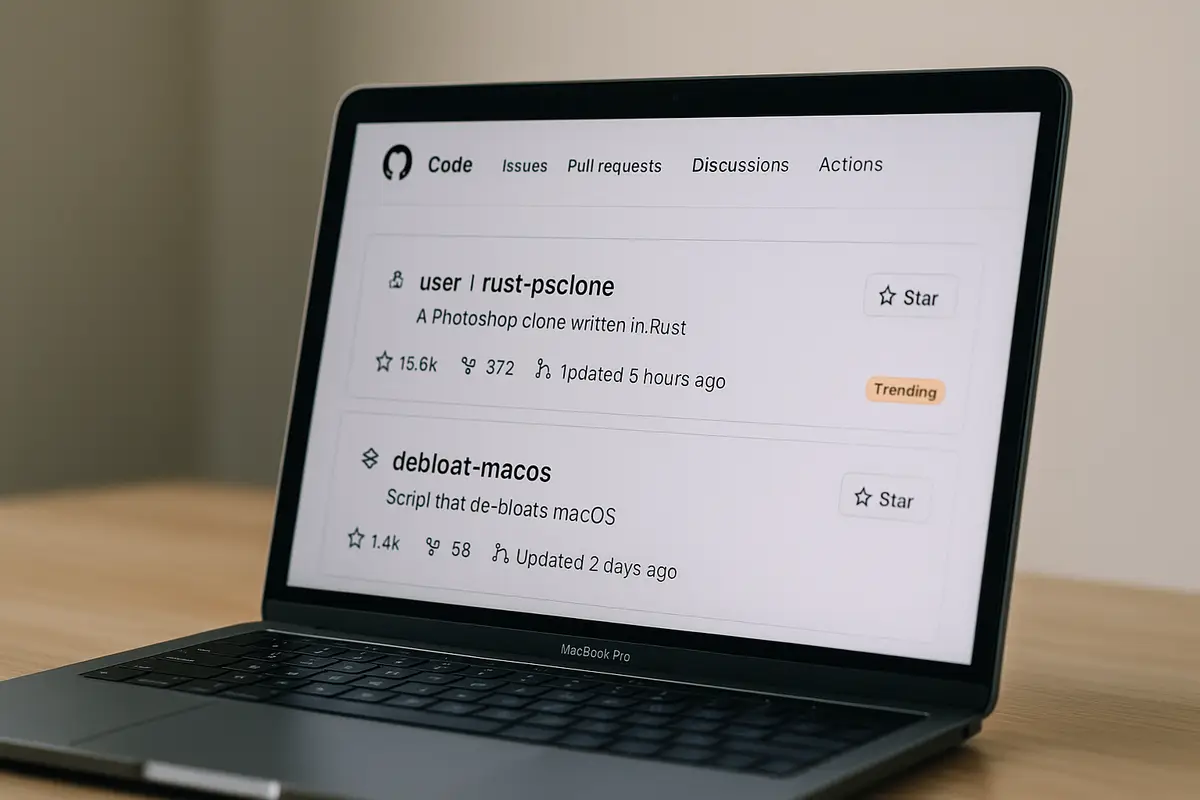
PhotoCraft, a Rust-based reimplementation of Adobe Photoshop, has accumulated 11,893 stars since launching seven days ago, gaining roughly 1,726 stars per day. The project claims to be a 'clean-room' rebuild—meaning developers wrote it without access to Adobe's source code, reverse-engineering only the visible behavior and user experience. Written in Rust with an Apache 2.0 license, PhotoCraft targets image editing workflows from scratch, directly competing with a $55-billion-market-cap company's flagship product. The sheer velocity suggests this isn't casual tinkering: 1,561 forks in one week indicates serious forks from maintainers and contributors preparing to extend or customize the codebase. Concurrently, RemoveMacAI—a Swift-based CLI and native app for stripping Apple Intelligence, analytics, and system pop-ups from macOS—has gained 3,314 stars in eight days. Both projects are solving concrete pain points: Adobe's subscription model and feature bloat for creatives, and Apple's aggressive data collection for macOS users who value privacy.
What distinguishes these projects from typical 'proof of concept' rewrites is their technical ambition and maintenance intent. PhotoCraft's choice of Rust signals serious performance engineering from day one; creators aren't building a toy. RemoveMacAI went further, offering undo capability for every system modification—a detail suggesting deep product thinking, not a weekend hack. The projects also share a structural insight: both target platforms where users have historically felt trapped. Adobe's dominance in creative workflows and Apple's control over its ecosystem create natural monopoly rents that a single determined open-source effort can challenge. GitHub trending data shows developers recognize this: openai/math (6,557 stars in one day) and openGym (6,281 stars, a fitness tracker gaining 1,419 today) are also trending, but PhotoCraft and RemoveMacAI's star velocity reflects something different—they're not filling niche gaps; they're attempting wholesale replacement of incumbents.
The broader signal is clear: after years of vendor consolidation and privacy concerns, developers are voting with their keyboards. These projects may or may not become production-ready alternatives—PhotoCraft's timeline to feature parity with Adobe is years away, and RemoveMacAI is technically a configuration tool, not a platform. Yet their GitHub reception reveals where developer sentiment has shifted most sharply: toward rebuilding tools they've lost control over, reclaiming data sovereignty, and rejecting subscription fatigue. Whether these specific projects succeed is secondary to what their trending status signals: the open-source community is ready to bet significant attention and forks on ambitious reimplementations. That's not nostalgia or hobby coding—it's the market responding to perceived market failure.