
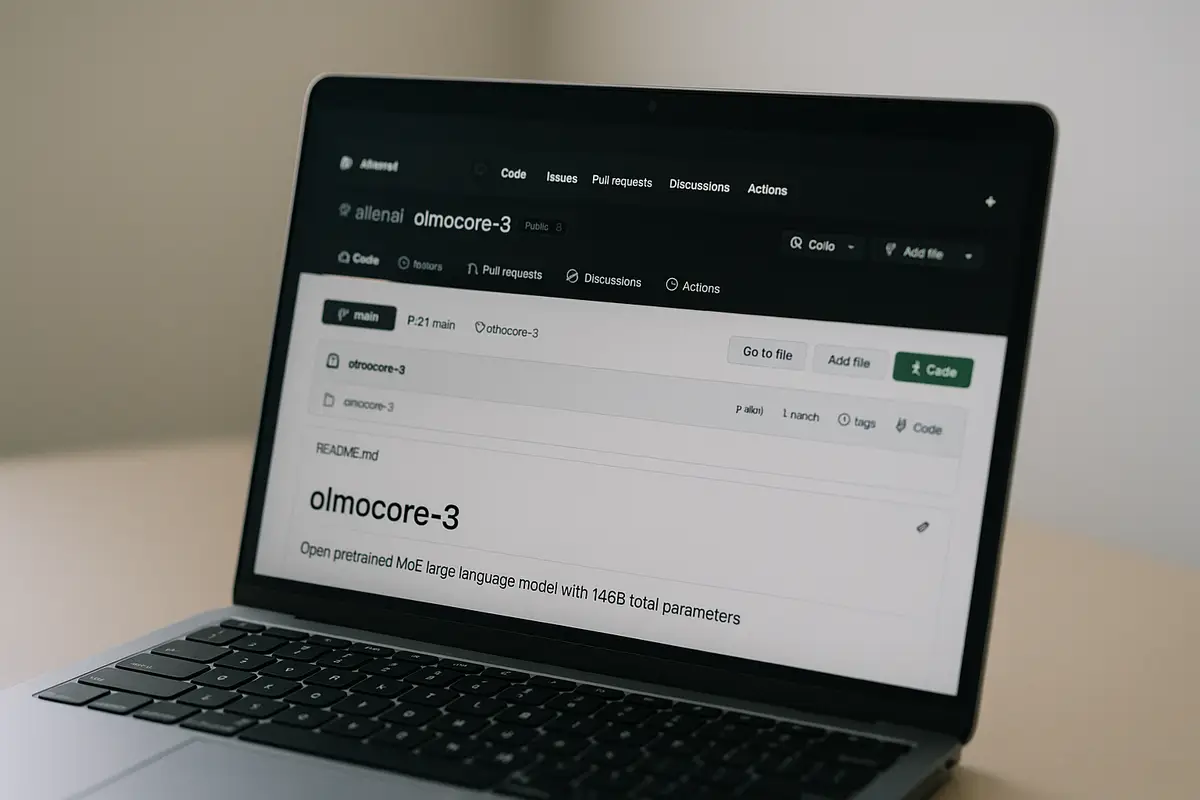
The Allen Institute for AI has released Olmo-core 3, an open-source training infrastructure specifically engineered for scalable Mixture-of-Experts (MoE) models. Unlike previous approaches that required proprietary frameworks or cloud-locked training pipelines, Olmo-core 3 abstracts away the complexity of distributed MoE training—token routing, expert load balancing, and inter-node communication—into a configurable, self-hostable system. This addresses a critical bottleneck: MoE architectures are theoretically more efficient than dense models (requiring 5-10x fewer total parameters to match dense performance), but historically they've demanded specialized expertise and infrastructure only accessible to well-funded labs. Early adopters report that Olmo-core 3 reduces the engineering overhead for training custom MoE models from weeks of systems work to days of configuration.
The technical innovation centers on how Olmo-core 3 handles the routing problem—the core challenge of MoE systems. Instead of a fixed, centralized router that becomes a bottleneck, the framework implements adaptive load balancing with auxiliary loss objectives that prevent token clustering onto a few high-capacity experts. It supports both sparse and dense gating mechanisms, allowing researchers to trade off between computational efficiency and routing simplicity. The infrastructure handles gradient synchronization across expert boundaries without the communication overhead that typically plagues distributed MoE training. A researcher at a mid-sized university stated: "We were running dense 13B models; with Olmo-core 3, we're now training 70B parameter MoE models on the same GPU cluster in comparable wall-clock time because the sparse computation actually wins out." The framework includes profiling tools that reveal where bottlenecks exist in your specific setup—whether it's network saturation, uneven expert utilization, or training instability.
This release matters because it directly enables the open-source ecosystem to compete in scaling research. Previously, breakthrough MoE work came almost exclusively from teams with access to thousands of GPUs. Olmo-core 3 shifts this by reducing the effective compute requirement—a researcher with a 128-GPU cluster can now run experiments in parameter-efficient architectures that previously required 512+ GPUs at a centralized facility. Several independent labs have already begun publishing results using Olmo-core 3, including experiments in specialized domains like scientific computing and code generation, where model efficiency is critical. The framework is production-ready and available on GitHub under an open license, with documentation targeting researchers familiar with PyTorch but new to distributed training. For the open-source AI community, this is a tangible capability shift: MoE research is no longer concentrated in the hands of a few institutions.