
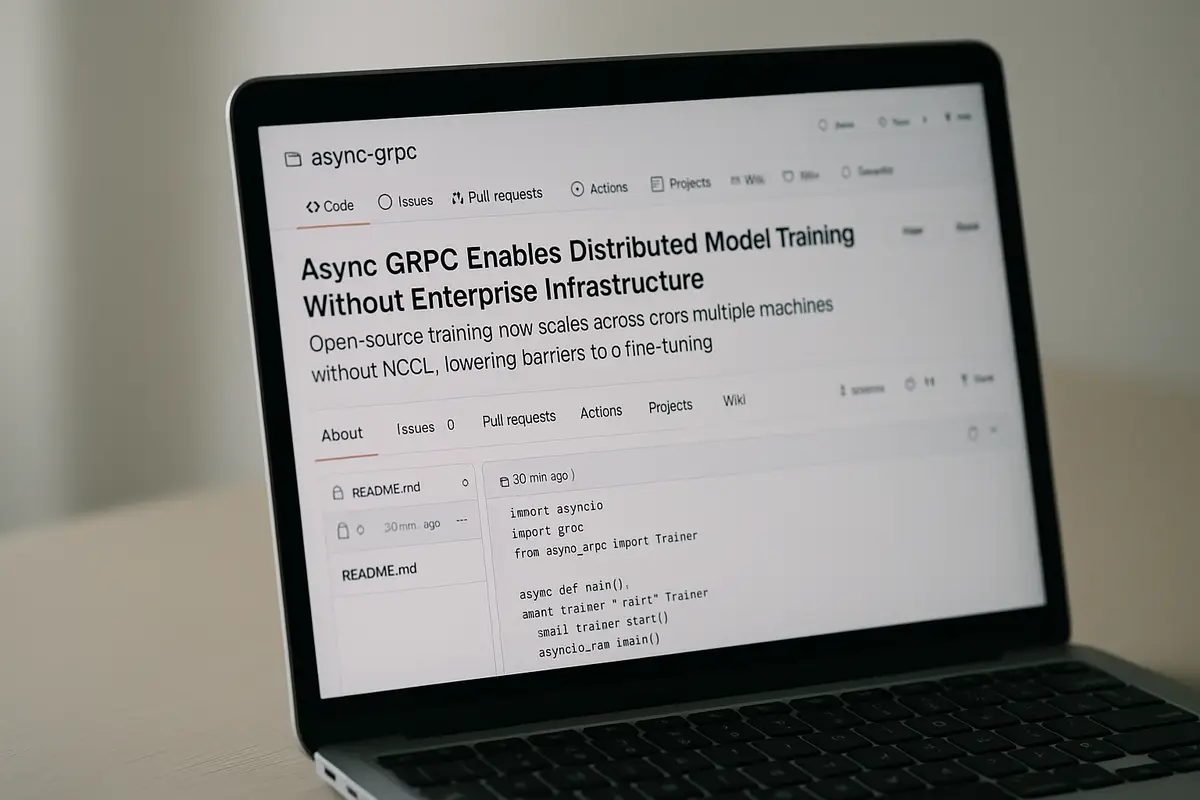
The open-source AI community has long faced a critical bottleneck: fine-tuning large language models at scale traditionally required expensive distributed training infrastructure, particularly NCCL (NVIDIA Collective Communications Library) support and tightly coordinated compute clusters. This barrier kept model customization out of reach for most organizations and individual developers. A new approach using Async GRPO (Generalized Reward Policy Optimization) with LoRA across HuggingFace Jobs sidesteps this requirement entirely, using only a bucket for checkpoint storage and a lightweight proxy for coordination. The technique enables asynchronous gradient updates across multiple machines without requiring the low-latency, hardware-synchronized communication that NCCL demands. This opens distributed training to teams running on heterogeneous infrastructure—commodity cloud instances, on-premises hardware, or even geographically dispersed machines with unreliable networking.
The significance lies in practical accessibility. Financial institutions can now fine-tune models on proprietary transaction data without routing data through third-party infrastructure. Healthcare organizations can adapt models to clinical terminology and regional protocols while keeping sensitive patient data entirely local. Smaller companies can meaningfully customize open models for niche domains—legal discovery, manufacturing diagnostics, customer support—without the capital expenditure previously required. HuggingFace Jobs integration means teams can orchestrate training runs directly from their model repositories, reducing DevOps complexity. This democratization effect is already visible in related ecosystem developments: the rebuild of AUTOMATIC1111 with Gradio Workflow provides similar infrastructure-agnostic composability for image generation pipelines, and the emergence of coding-agent frameworks like Cloudflare's security-audit skill demonstrates that fine-tuned local models are becoming the foundation for specialized AI agents rather than closed API calls.
The broader trend reflects open-source AI's maturation toward genuine self-hosting. NeoMME, an efficient multimodal encoder, exemplifies parallel progress—models designed to run locally with reasonable resource constraints, not stripped-down approximations of cloud alternatives. Combined with async distributed training, this means organizations can now build complete workflows: train custom vision-language models on proprietary data, deploy them locally for inference, and iterate without external dependencies. As these tools stabilize, the economic calculus shifts decisively away from API consumption toward ownership and control, particularly for use cases involving sensitive data, regulatory compliance, or long-term cost predictability. The infrastructure barriers that made open models feel incomplete are quietly disappearing.